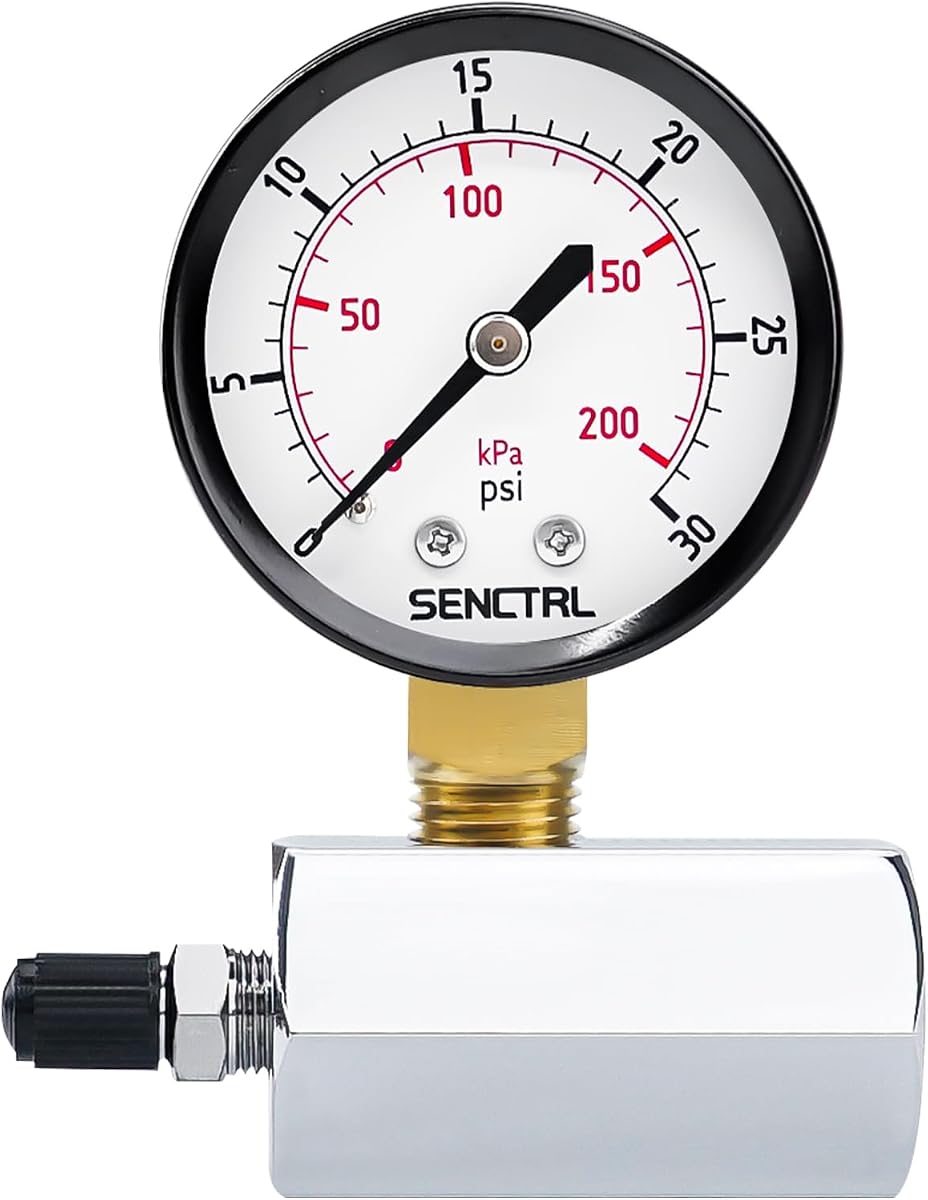
SENCTRL 0-30 Psi Gas Pressure Test Gauge
4.5Editor score
Chrome plated steel body assembly
Dual scale 0-30 psi and kPa
3/4 inch FNPT connection
A reliable gas line pressure gauge is essential for homeowners and technicians who need to monitor natural gas or propane systems safely. Without accurate measurements, you cannot ensure appliances are functioning correctly or detect dangerous leaks before they become hazards.
We evaluated ten leading models based on build quality, dial clarity, connection compatibility, and overall value. Our analysis focuses on how well each unit performs in real-world scenarios ranging from residential leak checks to manifold pressure verification.
Each pick highlights specific strengths like corrosion resistance or dual-scale reading options to help you choose the right tool for your needs. Please note that availability and pricing may fluctuate over time, so check the current listings before purchasing.
4.5Editor score

4.3Editor score

4.7Editor score
As an Amazon Associate we earn from qualifying purchases.
The following table provides a side-by-side comparison of all ten selected gas line pressure gauge models, detailing their key specifications and unique features to help you make an informed decision quickly.


The SENCTRL pressure test gauge assembly offers an excellent entry point for anyone needing to monitor gas lines. With a 4.5 rating it delivers consistent performance for residential checks without breaking the bank.
We may earn a commission when you buy through this link, at no additional cost to you.
Its dual scale allows you to read both psi and kilopascals easily while the chrome plated steel body ensures longevity. The 3/4 inch FNPT connection integrates directly into standard household setups.
While the range is limited to 30 psi which suits most home applications the basic steel case lacks the ruggedness of premium units. This trade-off is acceptable given the low cost and functional design.
Homeowners looking for a straightforward tool to test natural gas lines should consider this model. It provides the essential measurements needed for safety checks at a fraction of the cost of professional kits.
The 3/4 inch female NPT thread allows you to screw the unit directly into the gas line without needing extra adapters.
A black steel case surrounds the dial to protect it from rust and environmental damage during storage or outdoor use.
We may earn a commission when you buy through this link, at no additional cost to you.
The Uharbour natural gas pressure tester stands out for its robust forged brass construction which ensures it can withstand harsh conditions. With a 4.3 rating it is trusted for its reliability in both indoor and underground settings.
We may earn a commission when you buy through this link, at no additional cost to you.
Its 2 inch transparent steel air pressure gauge offers superior readability compared to standard plastic cases. The dual scale bar and psi makes it versatile for different user preferences and international standards.
Users must ensure they wrap PTFE tape properly before use to avoid leaks as the connection relies on manual tightening. While durable the brass construction can be heavier than aluminum alternatives.
Professionals or serious DIYers who need a tool that will last for years should choose this brass tester. It balances build quality and accuracy effectively for critical gas line inspections.
Cup-shaped forged brass ensures the measuring device resists corrosion and extends the overall life of the gauge significantly.
This model is specifically noted for being important for testing leaks in underground gas lines where durability is crucial.
We may earn a commission when you buy through this link, at no additional cost to you.
The MEANLIN MEASURE manifold gas pressure test kit is a top tier option with a 4.7 rating for its comprehensive design. It is built specifically for measuring low pressure in natural gas or LP gas systems across appliance manifolds.
We may earn a commission when you buy through this link, at no additional cost to you.
An extended 40 inch hose brings the gauge closer to you while testing appliances far from the gas source. The 1/8 inch NPT fitting with barbed connection ensures you can connect to various systems securely.
Although it is priced higher than basic gauges the included hex bushing and zero adjustable settings justify the cost for professional needs. The temperature range supports both indoor and outdoor testing scenarios safely.
Technicians who need precision for manifold pressure verification should invest in this kit. It offers the flexibility and accuracy required for detailed HVAC and gas appliance diagnostics.
The 40 inch hose brings a longer distance to meet the needs of different scenarios during complex installations.
Hex bushings allow you to adapt the gauge to different pipe sizes ensuring a solid connection every time.
We may earn a commission when you buy through this link, at no additional cost to you.
This gas test gauge assembly provides a higher 60 PSI range than standard models which suits more demanding industrial needs. With a 4.3 rating it balances capacity and readability for various testing applications.
We may earn a commission when you buy through this link, at no additional cost to you.
The 2 inch pressure gauge features a durable glass lens that does not fade over time ensuring clear readings. The brass valve and sturdy steel case make it robust for repeated heavy use.
The bell shape body is sturdy but can make storage in tight toolboxes difficult. Also the weight of the forged steel might be excessive for simple household checks.
If you require a gauge that can handle higher pressure spikes this model is an excellent choice. It offers durability and clarity for situations where standard 30 PSI units fall short.
The range extends to 60 PSI which is useful for systems that operate above standard residential pressure levels.
A non fading glass lens protects the dial numbers ensuring they remain visible even after years of exposure.
We may earn a commission when you buy through this link, at no additional cost to you.
The MEASUREMAN gas pressure test gauge assembly is designed for pressure testing on gas lines with reliable accuracy. It holds a 4.3 rating for its solid brass construction and clear dial readability.
We may earn a commission when you buy through this link, at no additional cost to you.
With a 2-1/2 inch dial size this unit offers more room to see numbers clearly. The brass wetted parts ensure compatibility with gas without corrosion risks over time.
The dry internal movement keeps moisture away from the mechanism which is vital for long term performance. However the basic design means it lacks some of the advanced features found in manifold kits.
For general purpose gas line pressure testing this gauge provides a reliable solution. It is a good middle ground between cost and performance for regular maintenance checks.
The use of brass where the gas touches ensures durability and prevents corrosion that could lead to leaks.
The 2-1/2 inch dial makes it easier to read pressure values quickly even in low light conditions.
We may earn a commission when you buy through this link, at no additional cost to you.
While primarily a fuel kit this model is relevant for those managing engine fuel lines which share similar pressure monitoring needs. It has a 4.4 rating for its ability to diagnose issues like leaks or regulator failures.
We may earn a commission when you buy through this link, at no additional cost to you.
The double scale gauge displays 0-7 bar and 0-100 psi for clear reading. Adapters cover 6.30mm 7.89mm and 9.49mm fittings making it versatile for different engine brands.
You must not use this on diesel engines as specified in the warning which limits its universal application. The rubber hose is durable but requires careful handling to avoid kinks during testing.
If you need a kit to troubleshoot vehicle fuel systems this is a strong candidate. It provides the necessary tools to identify low pressure or leaks without removing components.
Three size adapters cover SAE 1/4 5/16 and 3/8 standards for broad compatibility across engines.
It helps identify low fuel pressure faulty regulators and clogged fuel filters effectively during maintenance.
We may earn a commission when you buy through this link, at no additional cost to you.
This natural gas or LP gas manifold pressure test kit is ideal for measuring low pressure across appliance manifolds. It holds a 4.5 rating for its specific design which helps diagnose pressure drops at the source.
We may earn a commission when you buy through this link, at no additional cost to you.
The 40 inch rubber hose provides excellent reach to appliances that are mounted high or deep. The 1/8 inch NPT male brass fitting connects easily to standard manifold ports.
The beryllium diaphragm capsule and brass movement ensure high precision for low pressure measurement. However the snap on acrylic window can scratch more easily than glass alternatives.
This kit is a must have for HVAC technicians who work with gas appliances regularly. It allows for accurate checks of natural gas and LP gas settings efficiently.
The beryllium diaphragm capsule helps deliver precise readings for the low pressure levels common in homes.
The unit fits into a molded plastic box protecting it during transport to job sites safely.
We may earn a commission when you buy through this link, at no additional cost to you.
The DANCO gas test gauge is designed specifically to gauge the pressure of gas in your tank up to 15 psi. It has a 4.2 rating for its ability to provide detailed measurements with 1/10th increments.
We may earn a commission when you buy through this link, at no additional cost to you.
Its clear facing helps you see pressure measurements with ease which is crucial for small adjustments. The chrome plated brass body offers a sturdy feel while maintaining corrosion resistance.
The low range limits it to tanks or low pressure systems where precision is more important than high pressure handling. The plastic face is durable but can break if dropped heavily.
If you need to check propane tank levels or low pressure lines this gauge is a reliable choice. It gives you fine control over the reading for detailed verification.
Using 1/10th increments allows you to see small changes in pressure that other gauges might miss.
Designed to gauge pressure in tanks this tool is essential for ensuring safe fuel levels.
We may earn a commission when you buy through this link, at no additional cost to you.
This fuel pressure gauge kit is designed for monitoring performance in automotive fuel systems. It features a 4.4 rating for its glycerin filled design which ensures stable readings even when the engine vibrates.
We may earn a commission when you buy through this link, at no additional cost to you.
The inline fuel pressure gauge is easy to install with center back mount options for accessibility. The brass barb fittings cover 3/8 and 5/16 sizes making it versatile for different fuel lines.
Glycerin filling reduces needle vibration which helps you read the pressure accurately while the engine is running. The stainless steel construction ensures it holds up to heat and corrosion.
For car enthusiasts or mechanics who need to tune performance this gauge is very useful. It allows you to fine tune fuel pressure for optimal engine efficiency reliably.
Glycerin filled design provides stable readings by absorbing vibration from the engine during operation.
Designed for inline installation this gauge lets you monitor pressure without disconnecting the entire system.
We may earn a commission when you buy through this link, at no additional cost to you.
The OTC 5630 Fuel Pressure Test Kit is a professional grade tool designed to quickly locate malfunctioning components. With a 4.5 rating it is trusted for its reliability in heavy duty automotive testing environments.
We may earn a commission when you buy through this link, at no additional cost to you.
Its large easy to read gauge features an impact resistant rubber encased housing to protect against drops. The high quality solid brass fittings and hose ensure long lasting performance on daily jobs.
A convenient pressure relief valve allows for safe and clean testing which reduces the risk of spills. The kit is priced higher than entry level models but the durability justifies the investment.
Professional mechanics who need a tool that can withstand daily wear and tear should consider this kit. It provides a complete solution for fuel system diagnostics with high safety standards.
Quickly finds bad filters regulators and pumps without removing them from the vehicle body save time.
The pressure relief valve helps maintain safety by allowing controlled release during testing procedures.
We may earn a commission when you buy through this link, at no additional cost to you.
Selecting the right gas line pressure gauge requires understanding your specific system needs and the environment where the tool will be used. The following factors will help you narrow down the options to find the most suitable model.
Most residential gas gauges operate between 0-30 PSI while industrial units may go up to 60 PSI or higher. Always check the maximum pressure rating of your gas line to ensure the gauge does not exceed its safety limit during testing.
Choose a gauge with a range that fully covers your expected operating pressure to maintain accuracy and avoid damage.
Gas line gauges typically use 3/4 inch FNPT or MPT threads to fit directly into household piping. Some specialized kits for manifolds use 1/8 inch NPT fittings which require adapters if you are testing a main line.
Verify the thread size of your gas valve before purchasing to ensure a direct and leak free connection without extra parts.
Brass and forged steel bodies are preferred for their corrosion resistance and durability against environmental factors. A black steel case or rubber housing protects the dial from impacts and UV exposure during outdoor use.
Opt for brass wetted parts to ensure the internal components do not react with the gas or moisture over time.
Look for gauges that meet ASME B40.100 accuracy standards which guarantee precise measurements within a specific percentage. Higher accuracy is critical when testing for leaks or adjusting regulator settings for appliances.
A standard accuracy of +/-3-2-3% is acceptable for general testing but precision work may require tighter tolerances.
Manifold test kits often include a 40 inch rubber hose to reach appliances located far from the gas source. A longer hose reduces the need to move heavy tools or crouch in tight spaces during inspection.
Ensure the hose is durable and kink resistant to maintain steady flow and accurate readings during use.
A 2 inch dial face is standard and provides enough room to read numbers clearly. Dual scales showing both psi and kPa or bar are helpful if you work with international standards or different appliance types.
Choose a model with a clear transparent window that resists scratches to ensure long term readability.
Some gauges are specifically designed for fuel systems while others are for natural gas or propane. Using a fuel specific gauge on a gas line may not provide accurate results due to different pressure characteristics.
Always select a gauge labeled for gas line or manifold testing to ensure safe and reliable performance.
Basic gauges can cost under ten dollars but professional kits with hoses and accessories will cost more. Invest in a higher quality unit if you plan to use it frequently or for critical safety inspections.
Balance your budget with the frequency of use to find a gauge that offers the best value for your needs.
Before connecting the gauge, ensure all gas shut-off valves are closed and the system is depressurized. Attach the gauge to the test port using the appropriate thread adapter and wrap PTFE tape around the threads to prevent leaks.
Slowly open the gas supply valve and observe the needle as it settles. Record the steady reading on the dial and compare it to the manufacturer recommended pressure range for your specific appliances.
After testing, close the gas supply valve and release any remaining pressure by opening the relief valve if available. Store the gauge in a protective case to avoid damage from dust or accidental drops between uses.
Most residential natural gas systems operate at low pressures around 5 to 7 inches of water column which is roughly 0.2 to 0.3 PSI. For propane or LP gas the pressure is slightly higher around 10 to 12 inches of water column.
It is not recommended to use a fuel pressure gauge on a gas line because the pressure ranges and connection fittings are different. Gas line gauges are designed to handle the specific characteristics of natural gas and propane safely.
A low reading often indicates a leak in the line or a faulty regulator that is not supplying enough pressure. It can also mean a blocked vent or a malfunctioning appliance causing pressure drops in the system.
To prevent leaks, wrap the threads of the gauge or adapter with PTFE tape before screwing it into the port. Tighten the connection by hand first then use a wrench to secure it without over-tightening.
While 3/4 inch FNPT is common for main gas lines, manifold kits often use 1/8 inch NPT fittings. Always check your specific appliance or valve port to ensure the gauge matches the connection size.
Always work in a well ventilated area to avoid gas accumulation during testing. Do not use an open flame or electrical devices that could spark near the gas source while checking for leaks.
We reviewed ten top gas line pressure gauge models ranging from basic handheld units to comprehensive manifold kits. Each option offers specific features to help you monitor pressure safely and effectively in different scenarios.
When selecting a gauge prioritize accuracy and connection compatibility to ensure your measurements are reliable. Consider the build material and durability if you plan to use the tool frequently or in harsh environments.
Please remember that product availability and pricing can change over time so verify the current details before making your purchase. With the right gauge you can ensure your gas systems operate safely and efficiently.