
WWZMDiB 5 Pcs Power Supply Module
4.2Editor score
Five pack value bundle included
Compatible with 400 and 830 points
Includes five 9V connector cables
Discover the top rated 12V breadboard power supply options for makers. We compare features compatibility and performance to help you choose the right module.
Choosing the right power source is critical for electronics prototyping. A good 12V breadboard power supply provides stable voltage rails for microcontrollers sensors and circuits without the hassle of complex wiring or external benchtop units.
We evaluated ten popular modules based on compatibility safety features and ease of use. Our comparison covers standard MB102 adapters dual voltage options and versatile input methods to ensure you find a reliable solution for your workspace.
Each pick highlights key strengths and potential trade-offs for different projects. Note that product availability and pricing may change over time so always verify current details before making your final purchase decision today.
4.2Editor score

4.6Editor score

4.8Editor score
This side by side comparison outlines the core specifications and capabilities of each module. Use this table to quickly identify which power supply matches your specific voltage needs and breadboard type for your next electronics project.




This dual pack module offers significant value for makers needing multiple power sources. It supports modern Type-C and classic DC inputs for flexible powering options in any lab or workspace environment.
We may earn a commission when you buy through this link, at no additional cost to you.
The independent right and left channel controls allow you to run different voltage rails simultaneously. This feature is essential when powering mixed logic level circuits without complex external wiring setups.
While the LED indicators are helpful they cannot be dimmed for low light work. The flush design saves space but requires precise placement to avoid blocking tie points on dense boards.
This module is ideal for students and teams running parallel projects. Its protection features and convenient input options make it a strong candidate for general purpose breadboard power needs.
Supporting both Type-C and DC jacks ensures you can use standard phone chargers or wall adapters without hunting for obsolete cables.
You can power one side at 3.3V and the other at 5V simultaneously giving you maximum flexibility for diverse prototyping circuits.
We may earn a commission when you buy through this link, at no additional cost to you.
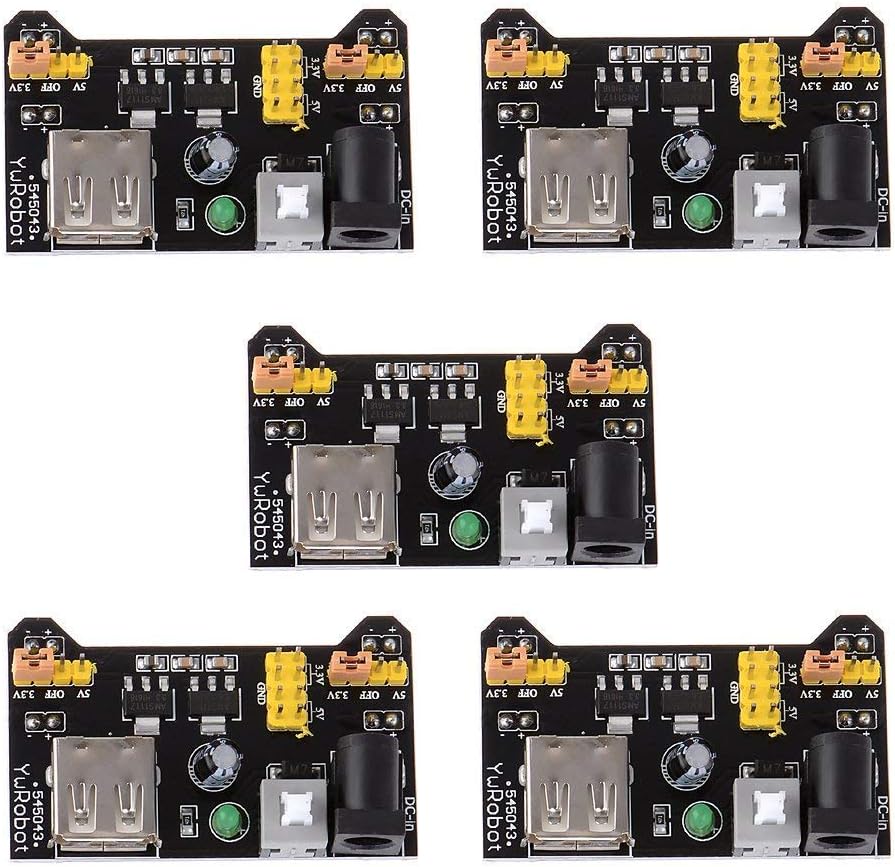
This five piece set provides excellent value for classrooms or hobby groups needing multiple power sources. Each module fits standard 400 and 830 point solderless breadboards securely.
We may earn a commission when you buy through this link, at no additional cost to you.
The included 9V connector cables add convenience for battery powered prototypes. You can easily switch between wall power and battery packs without additional wiring or adapters.
The maximum output current is below 700mA which limits high current applications. Build quality is functional but basic compared to premium single units with more robust components.
Choose this pack for educational settings or large workshops. The low cost per unit makes it easy to replace modules if one fails during heavy classroom use.
These modules are designed to fit both 400 point and 830 point breadboards ensuring wide use across different prototyping setups.
Included 9V connectors allow you to power projects on the go using standard battery packs without needing a wall outlet.
We may earn a commission when you buy through this link, at no additional cost to you.
This comprehensive kit includes everything needed to start prototyping immediately. It provides a stable 12V 1A adapter along with an 830 point breadboard for extensive circuit building.
We may earn a commission when you buy through this link, at no additional cost to you.
The power module supports 5V and 3.3V outputs with two way independent control. This setup simplifies power management for Arduino and Pi projects requiring dual voltage rails.
The included 65 colorful jumper wires save time on initial setup. However the power adapter is standard and may not suit high current requirements beyond basic microcontroller use.
Ideal for students and beginners needing a full set. The combination of board power and wires removes the guesswork of sourcing compatible components separately.
This kit provides a power adapter breadboard module and jumpers in one package reducing setup time for new hobbyists starting out.
The included 12W adapter ensures stable power delivery for reliable testing of Arduino Raspberry Pi and STM32 based projects.
We may earn a commission when you buy through this link, at no additional cost to you.
HiLetgo is a trusted brand for basic electronics modules offering five units in one package. Each module fits MB102 breadboards directly for immediate power distribution without extra wiring.
We may earn a commission when you buy through this link, at no additional cost to you.
The design supports DC or USB power input allowing flexible use in labs or mobile setups. Output pins are clearly marked for 3.3V and 5V rails.
The input range is limited to 6.5 to 9V for DC which restricts use with higher voltage sources. Individual channels lack switches meaning you control power via the main input.
This pack suits labs needing multiple simple modules. The consistent quality and easy installation make it a practical choice for routine prototyping tasks.
These modules plug directly into MB102 breadboard rails eliminating the need for soldering or complex wiring to get started.
You can power these modules using standard USB or DC inputs allowing flexibility based on your available power sources.
We may earn a commission when you buy through this link, at no additional cost to you.
This module leads the list with high ratings for reliability and ease of use. It is designed for seamless integration with MB102 breadboards and major microcontrollers like ESP32 and Pi.
We may earn a commission when you buy through this link, at no additional cost to you.
Supporting both DC and USB inputs gives you flexibility whether in a lab or on the go. The selectable 3.3V and 5V outputs cover most low power sensor requirements efficiently.
The package includes only one unit which may be limiting for multiple stations. Jumper caps are required to select voltage levels adding a small step to setup.
This is the best overall choice for general electronics work. Its reliability and broad compatibility make it a safe recommendation for most hobbyist and student projects.
Designed to fit standard MB102 prototype breadboards this module works effortlessly with popular devices like Arduino and Raspberry Pi.
You can power this module via USB or DC input ensuring you can keep projects running with or without wall outlets.
We may earn a commission when you buy through this link, at no additional cost to you.
This set provides five modules with 9V connectors for flexible power configurations. It supports standard 400 and 830 point breadboards with direct plug in connections.
We may earn a commission when you buy through this link, at no additional cost to you.
The onboard self-locking switch allows easy power control with an LED indicator for status. Dual output design lets you switch between 3.3V and 5V easily.
Each module provides fixed regulated output with no individual channel control. This limits use when you need different voltages on the same breadboard simultaneously.
Ideal for classrooms or labs needing multiple units. The included connectors and switches simplify setup for groups sharing power sources during experiments.
A green LED indicator and self-locking switch make it easy to monitor and control power without fumbling for external switches.
You can output either 3.3V or 5V from either side of the breadboard to meet varied component voltage needs.
We may earn a commission when you buy through this link, at no additional cost to you.
This kit integrates multiple outputs into one board using the LM2596 regulator. It allows adjustable voltage levels with a built-in digital display for precise settings.
We may earn a commission when you buy through this link, at no additional cost to you.
The module reduces wiring errors by centralizing power outputs on a single board. It is ideal for workshops needing stable organized power without external regulators.
Assembly requires soldering which adds time compared to plug in modules. This limits it to users comfortable with basic soldering skills and circuit assembly.
Best for advanced makers wanting custom voltage needs. The adjustable output and display provide flexibility for circuits needing non-standard voltages during testing.
Fine-tune voltage levels with the built-in digital display to confirm settings before connecting your circuit and reducing trial and error.
Optional negative voltage support allows you to use this for analog circuits and advanced experiments beyond basic digital logic.
We may earn a commission when you buy through this link, at no additional cost to you.
This module offers higher current ratings suitable for Pi Pico and ESP32 with connected accessories. It includes an additional USB output for powering extra peripherals directly.
We may earn a commission when you buy through this link, at no additional cost to you.
The compact size makes it easy to fit on crowded boards without blocking tie points. Jumper caps allow you to adjust between 5V and 3.3V outputs easily.
Breadboard is not included in the package so you must source that separately. Output voltages are fixed which may limit use for circuits needing custom voltage levels.
Recommended for projects needing reliable power for higher current peripherals. The extra USB port and stable output make it a solid choice for advanced prototypes.
Provides stable and precise power output for reliable operation of your electronic projects without voltage drops or instability.
Its compact size allows you to continue experimenting and creating even in environments without easy access to power outlets.
We may earn a commission when you buy through this link, at no additional cost to you.
This switching power supply supports a wide input range from 5V to 40V making it highly versatile. It offers fixed outputs for 3.3V 5V and 12V plus an adjustable channel.
We may earn a commission when you buy through this link, at no additional cost to you.
With a high rating it proves reliable for diverse applications. The multiple channels allow you to power different components simultaneously without external regulators.
Setup is more complex and requires careful attention to wiring and voltage settings. It is better suited for users familiar with switching regulators than new hobbyists.
Best for advanced electronics labs needing flexible power. The wide input range and multiple channels make it a premium choice for complex circuit designs.
Supporting input from 5V to 40V allows you to use almost any DC source without needing specific adapters or converters.
The adjustable voltage channel lets you fine-tune output levels for specific components without needing extra regulators.
We may earn a commission when you buy through this link, at no additional cost to you.
This variable adapter supports 3V to 24V output with 3A capacity making it useful for diverse projects. It includes an LCD display showing real-time output voltage for precision.
We may earn a commission when you buy through this link, at no additional cost to you.
With twelve DC tips and alligator clips it adapts to many devices including breadboards. The high current capacity supports larger loads than typical breadboard modules.
It is not designed specifically for breadboards so you need clips to connect. The size is larger than modular units which may limit portability in tight workspaces.
Best for workshops needing a versatile bench power solution. The broad voltage range and tips make it ideal for testing and powering various electronics beyond prototyping.
The adapter can supply voltage between 3V and 24V with an LCD showing real-time output for precise control.
Included tips allow you to meet power requirements for different devices without buying separate adapters.
We may earn a commission when you buy through this link, at no additional cost to you.
Selecting the right module depends on your voltage needs current requirements and workflow. This guide covers key factors to consider before purchasing a power supply for prototyping.
Ensure the module accepts your available power sources. Most 12V breadboard supplies work with 6.5 to 12V DC or USB but some support wider ranges up to 40V for flexibility.
Check input limits to match your wall adapter or battery pack output before purchasing.
Look for modules that support 3.3V and 5V outputs for common microcontrollers. Some models include 12V or adjustable options if you need custom voltages for specific sensors or motors.
Select a module with the exact rails your projects require.
Typical modules provide up to 700mA which suits logic and sensors but not high current motors. Higher current models offering 1.5A or more are better for Pi with add-ons or wireless modules.
Verify current ratings to avoid brownouts during testing.
Most modules fit standard MB102 or 830 point breadboards directly. Ensure the connector matches your board type to avoid needing adapters that block tie points.
Confirm physical fit before purchasing for seamless integration.
Dual rail modules with independent switches let you run different voltages on one board. This is useful for mixed logic level circuits without extra external regulators.
Choose models with individual switches for flexible multi voltage setups.
Look for short circuit and over current protection to protect expensive components. Onboard fuses or electronic limits prevent damage if you accidentally miswire connections.
Prioritize modules with built-in protection for safe experimenting.
Compact units save tie points on smaller breadboards. Larger units may offer better cooling but can block rows if placed centrally on a dense circuit.
Consider size based on available board space and layout needs.
Buying in bulk packs can reduce cost per unit for classrooms or teams. Single units may offer better build quality but at a higher price point.
Decide if you need multiple modules or just one for immediate use.
Plug the module directly into the positive and negative power rails of your breadboard. Align the pins correctly to avoid short circuits before applying any power.
Connect your external adapter or battery to the DC or USB input. Use switches or jumpers to select your desired output voltage level.
Inspect modules for damage and keep them dry to extend lifespan. Avoid overloading current limits and remove from board when not in use for safety.
Most breadboard power supplies accept inputs between 6.5V and 12V to regulate down to 5V or 3.3V. Using a 12V adapter is safe as long as it matches the module input range.
Check that the module is seated firmly in the rails and input cables are connected correctly. Verify the power switch or jumper is set to the desired output.
Standard modules have labeled pins for 5V or 3.3V on one side and ground on the other. Always check the diagram or use a multimeter to confirm before connecting.
Most modules are rated under 700mA which is suitable for sensors and logic. For motors use a separate high current supply as motors can draw spikes that damage the regulator.
Linear modules are simpler and quieter but less efficient. Switching modules like those with LM2596 offer higher efficiency and support wider input ranges but are more complex.
Most modules use jumper caps to select voltage on each rail. Ensure you have the included jumpers or buy compatible ones to set your desired output level.
We reviewed ten options ranging from basic packs to advanced adjustable modules. The SHILLEHTEK Universal module stands out for reliability while bulk packs offer great value for groups.
Prioritize safety features and current capacity based on your project complexity. Beginners should start with simple plug-and-play units while advanced users may prefer adjustable switching regulators.
Always verify current stock and availability before purchasing as product details can change. Check the latest reviews and specifications to ensure you are selecting the right module for your needs today.