
XRDS-RF UHF Lightning Arrestor PL-259
4.6Editor score
Low insertion loss under 0.4dB
Brass nickel plated body construction
DC to 500MHz frequency range
This guide compares the top ham radio lightning protection for antennas to help you choose reliable surge arrestors that safeguard your equipment from storms
Ham radio operators invest heavily in transceivers and antennas that are vulnerable to lightning strikes. A quality protection device diverts dangerous surges to ground before they reach your gear. Choosing the right arrester ensures your station stays safe during severe weather events.
We evaluated ten leading lightning arrestors based on construction quality, signal loss, frequency range, and grounding features. Each product was assessed for compatibility with common coax connectors like PL-259 and N-Type. This list covers options for base stations, mobile setups, and budget-conscious builders.
Every pick includes detailed specs, pros, cons, and real-world usage notes to help you decide. Prices and availability change frequently so check current listings before purchasing. Protect your investment with the right surge protection tailored to your specific antenna system needs.
4.6Editor score

4.8Editor score

4.8Editor score
This side-by-side comparison highlights key specifications across all ten selected products to help you identify the best fit for your station.




This XRDS-RF arrestor is a top choice for budget-focused builders needing reliable surge protection. It scores a solid 4.6 rating from users who appreciate its simple design and low signal loss. The unit works well with standard PL-259 coax connectors on most HF and VHF antennas.
We may earn a commission when you buy through this link, at no additional cost to you.
Its construction features a brass body with nickel plating to resist corrosion in outdoor environments. The Teflon insulator ensures stable performance across frequencies from DC up to 500MHz. Insertion loss remains under 0.4dB which preserves your signal strength during normal transmission.
While effective, this model requires you to source a separate ground cable to complete the safety circuit. The housing is functional but lacks the premium finish of higher priced units. These trade-offs are acceptable given the low cost and strong protection capabilities.
Buy this if you need a basic arrestor for a base station or mobile setup without breaking the bank. It is ideal for new hams or temporary stations where cost is a primary concern. Pair it with a proper grounding rod for full safety compliance.
The 0.4dB insertion loss ensures your transmission stays strong without noticeable degradation.
Brass nickel plating protects the internal components from rust and weather exposure over time.
We may earn a commission when you buy through this link, at no additional cost to you.
The Diamond SP1000 is a high-performance arrester designed to protect valuable radios from violent surges. Users praise its 4.6 rating for consistent performance during thunderstorms. It integrates seamlessly into Diamond antenna systems and offers broad coaxial transmission line protection.
We may earn a commission when you buy through this link, at no additional cost to you.
Its standout feature is an extremely low insertion loss of under 0.3dB which keeps your signal clear. The impulse wave discharge capacity reaches 6000 Amps providing robust safety against direct strikes. Insulating resistance is very high ensuring no current leaks during normal operation.
The replaceable surge arrester element allows you to refresh protection after a major event without replacing the whole unit. While durable, the price is higher than generic options. You pay extra for the brand reliability and advanced safety features.
Choose this for mobile or base stations where equipment cost justifies premium protection. It is especially suitable if you already use Diamond antennas or coaxial gear. The long-term durability makes it a smart investment for serious operators.
With 6000 Amps capacity it can safely divert massive lightning energy away from your radio.
The internal element can be swapped out to restore full protection after a heavy surge.
We may earn a commission when you buy through this link, at no additional cost to you.
The Workman A28 is a no-fuss arrestor perfect for protecting basic CB and Ham base antennas. It holds a 4.5 rating for its simplicity and ease of installation. The design focuses on essential protection features without extra bells or whistles.
We may earn a commission when you buy through this link, at no additional cost to you.
Its male and female PL-259 connectors allow you to drop it straight into your existing coax line. The side ground screw makes attaching a grounding wire straightforward and secure. This helps direct unwanted voltage safely to earth ground.
The build is functional but feels lighter than premium units. It is not intended for extreme environments but works well for residential setups. You trade durability for an accessible price point that appeals to hobbyists.
Buy this for entry level stations or temporary setups where cost matters most. It provides necessary protection for radios that might otherwise be exposed to surges. Ensure your ground path is short and connected to a proper rod.
The dedicated ground screw on the side simplifies connecting your safety wire securely.
Compatible with any PL-259 coax cable to fit existing antenna systems immediately.
We may earn a commission when you buy through this link, at no additional cost to you.
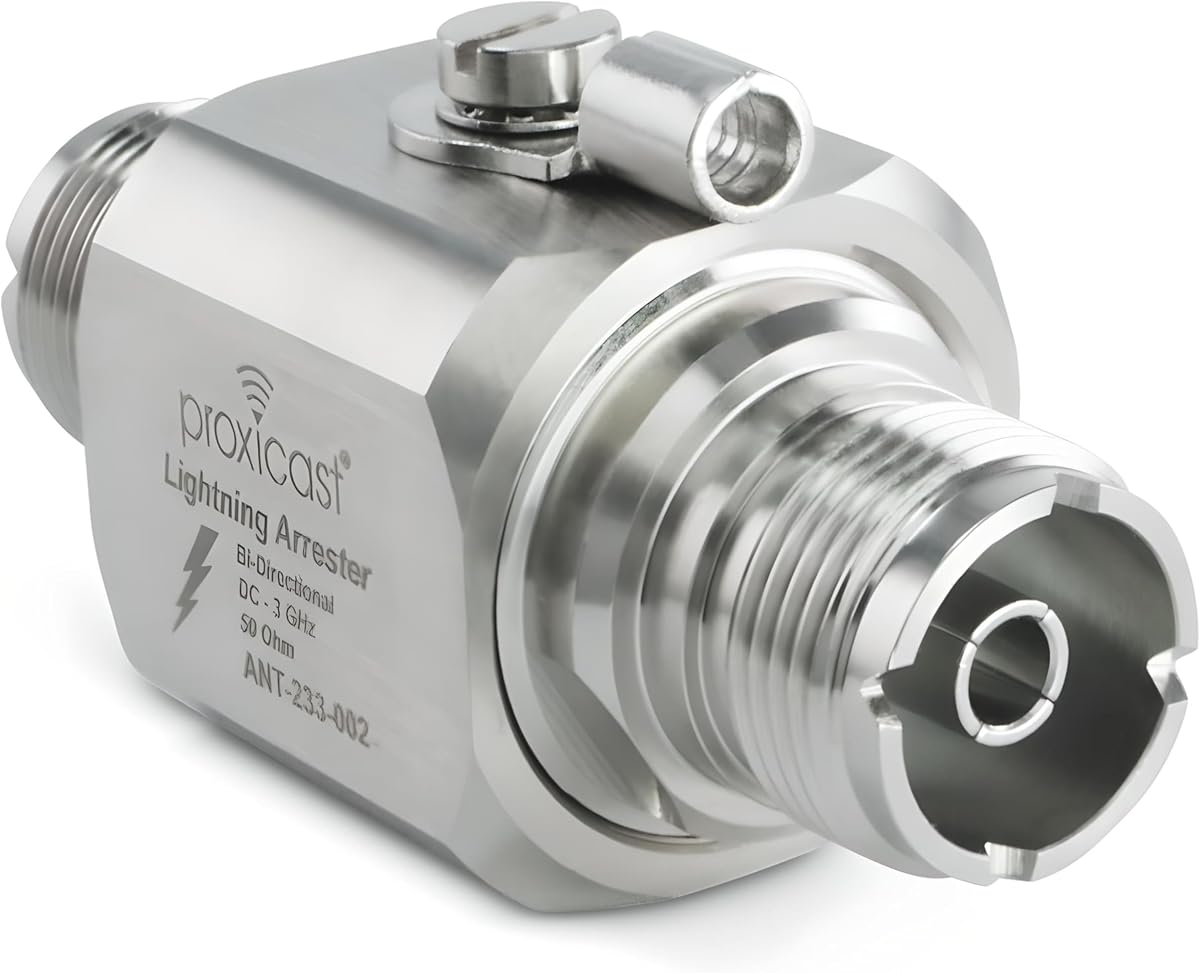
Proxicast ProGrade arrester uses a 230V gas discharge tube to shunt damaging energy away from your gear. It earns a 4.6 rating for reliable performance in VHF UHF and amateur radio bands. The bi-directional design protects both the antenna and the radio from surges.
We may earn a commission when you buy through this link, at no additional cost to you.
Its outdoor rated construction means it can withstand direct exposure to rain and UV light. The gas tube allows it to handle multiple strikes without needing replacement. DC pass-through capability ensures continuous power if your system uses remote bias.
Installation requires SO-239 connectors which may limit use on PL-259 lines without adapters. You should mount it near the entrance of your building for best protection. While versatile it is best for systems already using SO-239 feeds.
Use this for outdoor antennas or base stations needing robust multi-strike protection. It suits builders who want a professional grade device that lasts in harsh weather. Verify your connector type before ordering to avoid adapter needs.
The 230V tube activates only when voltage spikes protect normal signal flow uninterrupted.
Durable materials keep the internal components safe from water and sun degradation.
We may earn a commission when you buy through this link, at no additional cost to you.
This UHF arrester has earned a rare 5.0 user rating for its solid performance and included accessories. It features a sturdy aluminum housing that dissipates heat and resists rust. The design includes an earth lead making initial setup faster for new users.
We may earn a commission when you buy through this link, at no additional cost to you.
Internal protective components react instantly to surges without requiring fuse replacements. It works well with HF VHF and two-way radio setups. The female to female design fits standard coax cables directly into your antenna system.
You must connect the included earth lead securely to a ground terminal for protection to work. If ignored the device will not divert surges safely. Proper grounding is critical to achieving the high reliability users report.
Select this for any setup needing quick and reliable surge protection. The included ground lead reduces extra purchases and simplifies installation. Ideal for hams who want peace of mind during storm season without complex wiring.
An earth lead is included so you can connect to ground immediately upon arrival.
The metal body offers better heat dissipation and corrosion resistance than plastic.
We may earn a commission when you buy through this link, at no additional cost to you.
The SP3000 stands out as an Editor's Choice for its wideband capabilities from DC to 3000MHz. Users rate it 4.8 for its reliability and strong build quality. It is designed for high power applications up to 200W with robust N-Type connectors.
We may earn a commission when you buy through this link, at no additional cost to you.
N-Type connectors provide better shielding and durability than PL-259 especially at higher frequencies. The 1000V impulse wave discharge capacity handles significant surges effectively. This makes it suitable for towers or antennas exposed to open elements.
The main trade-off is the need for N-Type coax which can be less common in older setups. The cost is higher but justified by the extended frequency range and power handling. It is a premium device for serious station builders.
Choose this if you operate across multiple bands or need high power protection. It is ideal for towers where signal integrity and safety are both critical. Ensure your cabling matches the N-Type interface for best performance.
From DC to 3000MHz it covers HF VHF and UHF in one reliable device.
N-Type fittings offer superior weather sealing and signal integrity for outdoor use.
We may earn a commission when you buy through this link, at no additional cost to you.
This XRDS-RF model is designed for bulkhead mounting in enclosures or wall penetrations. It converts PL259 male to SO239 female providing flexibility for mixed connector systems. The 4.4 rating reflects solid protection with minor installation considerations.
We may earn a commission when you buy through this link, at no additional cost to you.
An integrated nut allows you to mount it securely through a panel or box. The 230V gas discharge tube ensures multi-strike protection against surges. Brass construction with nickel plating resists corrosion effectively in humid environments.
You need to cut an opening in your enclosure to use the bulkhead feature which may complicate retrofits. Performance is good but slightly lower rated than top tier units. This is a practical choice for custom builds.
Buy this for stations where you need to feed coax through a box or wall safely. It works well with amplifiers and outdoor enclosures needing a feedthrough protector. Plan your enclosure layout before purchasing to ensure fit.
The built-in nut simplifies securing the arrestor to any flat enclosure panel.
Converts between PL259 and SO239 to match mismatched cable and radio connectors.
We may earn a commission when you buy through this link, at no additional cost to you.
This two-pack offers great value for operators needing multiple arrestors for different antennas. Each unit has a brass nickel-plated outer conductor for corrosion resistance. Users rate the set 4.6 for consistent protection and durability over time.
We may earn a commission when you buy through this link, at no additional cost to you.
The PTFE insulating material protects the inner core from moisture and degradation. UHF female to female design allows series connection into existing lines easily. You can use them for home or professional setups across various RF fields.
While useful the housing is basic and requires you to source ground wires separately. The performance is reliable for standard base station needs but lacks premium features. Buying two at once saves cost if you run multiple stations.
Choose this if you have two antennas to protect and want a budget friendly solution. It is perfect for hobbyists expanding their setup without overspending on individual units. Ensure proper grounding for each unit to maximize safety.
Get two arrestors for the price of one to protect multiple stations affordably.
High quality PTFE ensures the internal core stays dry and electrically stable.
We may earn a commission when you buy through this link, at no additional cost to you.
RAIGEN offers premium protection across a massive 0 to 6 GHz spectrum covering Wi-Fi LoRa and Ham. It earns a 4.8 rating for its versatility and robust weatherproof build. The N-Type design ensures strong connections for outdoor IoT and telecom gear.
We may earn a commission when you buy through this link, at no additional cost to you.
A replaceable 90V gas discharge tube allows you to maintain protection after a strike. The included ground lug simplifies bonding to your building ground system. Heavy-duty brass plating guarantees long-term resistance to harsh elements.
The price is higher than basic options but justified by the wideband coverage and rebuildability. You must have N-Type compatible gear to use this unit. It is an investment for complex multi-device deployments.
Select this for professional IoT or off-grid solar nodes needing wideband protection. It is also great for hams using modern UHF and WiFi integrated setups. Ensure your ground path is solid to use the included lug effectively.
Protects everything from 2.4GHz Wi-Fi to 5GHz LTE and amateur bands effortlessly.
The gas tube can be swapped to restore protection without replacing the whole unit.
We may earn a commission when you buy through this link, at no additional cost to you.
The Opek LP-350a provides solid protection for CB and Ham radios handling up to 350 Watts. It holds a 4.6 rating for its dependable function and easy grounding. PL-259 connectors make it compatible with most standard coax cable systems.
We may earn a commission when you buy through this link, at no additional cost to you.
It includes a ground terminal to facilitate proper bonding to earth ground. The frequency range covers DC to 600MHz which suits HF VHF base stations well. The build is utilitarian focusing on core safety rather than aesthetics.
While reliable it does not offer high-end features like replaceable elements or wideband coverage. It serves well for lower power stations where cost efficiency is key. The 350 Watt capacity is sufficient for typical home use.
Buy this for affordable surge protection on entry level or mid-level rigs. It works well with CB radios and 2-way base stations needing reliable grounding. Ensure you connect the ground terminal for the device to function as intended.
Handles up to 350 Watts making it safe for moderate power amateur transmissions.
A dedicated terminal on the unit simplifies attaching your grounding cable.
We may earn a commission when you buy through this link, at no additional cost to you.
Choosing the right lightning protection requires understanding your station's connectors, frequency range, and safety needs. These factors ensure you select a device that protects without degrading your signal.
Most arrestors use PL-259 SO-239 or N-Type connectors. Ensure the unit matches your existing coax cables to avoid extra adapters. Mismatched connectors can increase loss and weaken weather resistance at connection points.
Check your radio and antenna connectors before purchasing to ensure a direct fit.
Surge protectors have specific frequency ranges like DC to 500MHz or DC to 6000MHz. Select a unit that covers all the bands you operate on to prevent performance drops. Wider bandwidth options offer flexibility if you plan to add bands later.
Match the device range to your operational HF VHF and UHF bands for best results.
Insertion loss measures how much signal the arrester absorbs during normal operation. Look for devices with low loss like under 0.4dB to keep your signal strong. High loss units can degrade weak signals and reduce your effective transmit power.
Prioritize low insertion loss specs to maintain clear communication quality during use.
This rating shows how much current the arrestor can safely divert to ground. Higher values like 6000 Amps offer better safety against direct or nearby strikes. Adequate capacity ensures the device won't fail during severe electrical storms.
Choose a high discharge capacity to guarantee your equipment survives major lightning events.
Weather-resistant materials like brass nickel plating prevent corrosion in outdoor mounts. Durable housing protects the internal gas tube from rain and UV light over time. Cheaper plastic units may degrade quickly if exposed to harsh elements.
Opt for metal bodies with protective plating to extend the service life of the device.
A surge protector only works if it is properly connected to a low impedance earth ground. Verify if the unit includes a ground wire or lug to simplify this process. Incomplete grounding renders the device ineffective regardless of its quality.
Ensure you have a proper grounding rod and short wire path before installing the arrestor.
Some devices have limits on the maximum watts they can handle during transmission. If you run 100W or more check that the arrestor supports your power level. Exceeding power ratings can cause internal damage and failure.
Verify the wattage rating matches your radio output to avoid overheating or breakdowns.
Higher-end models often feature replaceable gas discharge tubes or elements. This allows you to refresh protection after a strike without buying a new unit. It adds long-term value and reduces waste for serious station operators.
Consider models with replaceable internals if you expect frequent lightning activity in your area.
Install the arrestor inline between your antenna and your radio equipment. Place it as close as possible to the point where the cable enters your building. This ensures that any surge entering the feedline is diverted before it can damage your devices.
Connect the ground terminal securely to a low impedance earth ground using heavy gauge wire. Keep the ground wire as short and straight as possible to minimize impedance during a strike. A long coiled ground wire can reduce the effectiveness of the protection.
Inspect the arrestor annually for signs of corrosion or damage especially after storms. If your unit has a replaceable element check it after any major surge event. Replace the device if you notice physical cracking or persistent signal degradation.
Yes a ground rod is essential for any arrestor to function safely. The device directs surge energy to earth ground and without a proper path the energy can still reach your equipment. Always connect the arrestor to a dedicated ground rod or house grounding system.
Yes many arrestors are designed for mobile setups provided you can route a ground wire. Mobile arrestors often feature weatherproof enclosures to handle vibration and exposure. Ensure the ground connection is bonded to the vehicle chassis effectively.
A quality arrestor with low insertion loss will not significantly change your SWR. If you notice a high SWR after installation check your connections and coax cables. Ensure the arrestor is rated for your operating frequency range to avoid mismatches.
Most arrestors last for years unless they experience a direct or near strike. Inspect them annually and replace after any significant storm where you hear nearby thunder. If the internal gas tube fails it may show visible damage or signal loss.
Some arrestors like RAIGEN are explicitly designed for solar and IoT equipment. Always check the device specs to confirm compatibility with your specific power or signal lines. Standard RF arrestors may not match DC solar input requirements.
Bonding the coax shield at both ends helps reduce noise and RF burns on your gear. The arrestor handles lightning surges but additional grounding keeps the system safe from static buildup. Follow local codes for proper RF station grounding practices.
The top picks range from budget-friendly XRDS-RF units to premium RAIGEN multi-band protectors. Each option offers specific advantages depending on your connectors frequency needs and budget. Choosing the right device ensures your station remains safe during storms.
Prioritize proper grounding and connector compatibility above all else. A high-end arrestor will fail if not connected to a low impedance ground path. Invest in quality build materials to ensure long-term reliability in your outdoor setups.
Prices and stock change quickly so verify current listings before purchasing. Always consult the manufacturer documentation for specific installation requirements. Protecting your gear today saves significant repair costs during future storm seasons.