
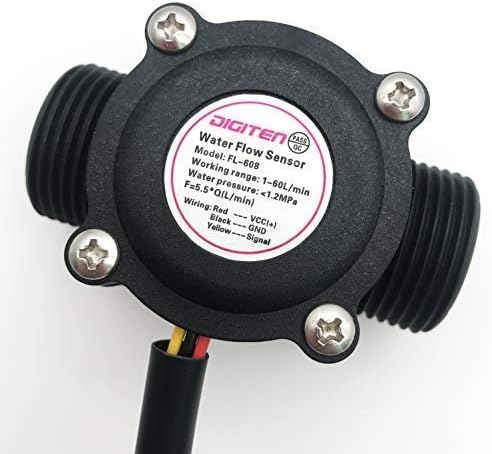
DIGITEN G3/8" Water Flow Sensor
4.5Editor score
Affordable price point
Low voltage operation 3.5-12V
Compact design for small spaces
Choosing the right Arduino flow meter is essential for projects involving water usage tracking, irrigation systems, or beverage dispensing. A reliable sensor ensures accurate data collection, helping you optimize resources and prevent leaks. With various options available, selecting the one that fits your specific flow range and pressure requirements is key to project success.
This guide compares ten top-rated flow sensors specifically designed or compatible with Arduino and Raspberry Pi platforms. We evaluated them based on build quality, signal output consistency, and ease of integration. Each product offers unique features, from transparent bodies for visual checks to extended cable lengths for flexible installation in tight spaces.
Each pick highlights specific strengths, such as food-grade materials, wide flow ranges, or robust hall effect sensors. Remember that prices can fluctuate, so checking the current listings is recommended before purchasing. Our detailed analysis helps you find the perfect sensor for your home automation, industrial, or hobbyist water management projects.
4.5Editor score

5.0Editor score

4.7Editor score
As an Amazon Associate we earn from qualifying purchases.
This side-by-side comparison highlights the key specifications and unique attributes of each selected flow sensor. Reviewing these details helps you match the sensor capabilities with your project requirements efficiently.


This DIGITEN sensor stands out for its robust performance and wide flow range, making it ideal for serious automation projects. With a perfect 5.0 rating, it delivers reliable data for Arduino and Raspberry Pi users. The hall effect technology ensures precise measurements even under varying pressure conditions.
We may earn a commission when you buy through this link, at no additional cost to you.
The sensor is built with materials meeting ROHS standards, ensuring safety for potable water applications. Its heat and pressure resistance make it suitable for water heaters and purifiers. The square wave output simplifies integration with microcontrollers, providing consistent pulses for accurate counting.
While it supports high flow rates, you must ensure your piping matches the G1.5 inch thread to avoid leaks. Using thread seal tape for NPT connections is necessary but straightforward. The slight learning curve for installation is outweighed by the long-term reliability and accuracy.
If you need a dependable sensor for industrial or heavy-duty home automation, this is the top recommendation. Its ability to handle large volumes of water efficiently makes it a versatile choice. The excellent user feedback confirms its value for projects requiring precise flow monitoring.
The 5-150L/min range allows this sensor to handle everything from small drips to high-volume industrial flows effectively.
Materials align with ROHS standards, ensuring the sensor is safe for drinking water systems and purification units.
We may earn a commission when you buy through this link, at no additional cost to you.
This budget-friendly option provides excellent value for hobbyists needing a reliable flow meter. The integrated magnetic hall effect sensor outputs pulses with every revolution, ensuring accurate counts. Its sealed design keeps electronics dry, extending the lifespan in wet environments.
We may earn a commission when you buy through this link, at no additional cost to you.
The sensor is small and easy to install, making it perfect for compact setups like coffee machines or reverse osmosis filters. The NPT thread simplifies connections to standard pipes. Despite the lower price, it maintains quality suitable for beverage machines and drinking fountains.
Installation requires attention to flow direction, as incorrect placement results in no signal. This is a common trait but worth noting. The limited 1-30L/min range suits household uses but might not fit large industrial needs.
For those starting with water flow monitoring on a budget, this sensor is a fantastic choice. Its reliability and ease of use make it a favorite among DIYers. The balance of cost and performance ensures satisfaction for most standard applications.
Sealing the hall effect sensor from the water pipe ensures durability and safety in continuous use scenarios.
Ideal for water heaters, coffee machines, and campus smart card equipment where precision and compactness matter.
We may earn a commission when you buy through this link, at no additional cost to you.
DEVMO offers a premium control switch designed for high-performance needs. The high amplitude output ensures clear signals even over longer distances or noisy environments. Its electrical strength rating provides confidence in durability against electrical stress.
We may earn a commission when you buy through this link, at no additional cost to you.
This sensor excels in water testing and cooling systems where reliability is paramount. The 1-30L/min range handles typical household and light industrial flows. The compatibility with Arduino makes it accessible for custom logic and automation scripts.
The price reflects the superior build quality and electrical specs. You must ensure your power supply matches the voltage requirements to avoid signal issues. However, the performance gain justifies the investment for critical systems.
If you need a control switch that offers robust signal integrity, this is the top pick. Its use in vending machines and flow measurement devices proves its stability. It bridges the gap between consumer hobby kits and industrial-grade components.
With high amplitude >= 4.6V, the signal remains strong and clear for reliable processing by microcontrollers.
Rated at 1250V/min, this sensor withstands electrical stress better than standard models, ensuring long-term reliability.
We may earn a commission when you buy through this link, at no additional cost to you.
Safety is paramount in beverage and food-related projects, and this sensor delivers. Constructed from food grade plastic, it is safe for potable water and liquid handling. The RoHS compliance ensures environmental standards are met.
We may earn a commission when you buy through this link, at no additional cost to you.
Its pressure tolerance up to 1.75Mpa allows use in systems with higher pressure than typical home plumbing. The wide voltage range of 5-24V offers flexibility in powering the sensor from various Arduino boards or external supplies.
The slightly lower rating may reflect plastic construction, which is lighter but potentially less impact-resistant than metal. For indoor, controlled environments, this is rarely an issue. The trade-off is a lighter, safer sensor for consumable liquids.
Choose this if your project involves mixing or dispensing liquids for consumption. Its safety certifications make it suitable for coffee machines and water purifiers. It remains a solid choice for hobbyists prioritizing material safety over ruggedness.
Food grade plastic and RoHS compliant raw materials ensure no harmful leaching into drinks or water.
Operating between 5V and 24V, it adapts easily to different power configurations in your setup.
We may earn a commission when you buy through this link, at no additional cost to you.
Transparency adds a unique benefit by allowing you to see water flow and rotor condition directly. This helps troubleshoot blockages or verify flow without stopping the system. It is particularly useful for educational projects where visibility aids learning.
We may earn a commission when you buy through this link, at no additional cost to you.
The YF-S201C includes stainless steel beads in the impeller, enhancing wear resistance. The transparent body is made of quality plastic meeting testing standards. Each pack includes two sensors, offering value for multiple project setups.
The rating is lower, possibly due to the plastic body's fragility compared to metal options. However, for low-pressure household water systems, it is sufficient. The visual advantage often outweighs the minor durability concerns for hobbyists.
Select this for projects where observing the rotor is essential. It works well with automatic water dispensers and card readers. The dual-pack ensures you have a spare if one gets damaged during prototyping or testing.
The transparent valve body allows real-time observation of water flow and impeller movement for quick diagnostics.
Buying two sensors together provides redundancy for large projects or backup options for future builds.
We may earn a commission when you buy through this link, at no additional cost to you.
For projects involving small hoses or low flow rates, this sensor is perfectly sized. The G1/4 inch connector fits hosepipes with 5 to 7mm inner diameter, making it versatile for drip irrigation or small pumps. The compact design fits into tight spots easily.
We may earn a commission when you buy through this link, at no additional cost to you.
The 0.3-6L/min range is ideal for delicate systems where high flow would be detrimental. Food grade plastic ensures safety if used for drinking water systems. It is compatible with Arduino for precise flow control in automation.
Its pressure limit of 0.8Mpa is lower than larger models, so it should not be used in high-pressure mains. This is a specific use-case sensor rather than a general one. If your flow requirements match, it performs accurately and efficiently.
Use this for aquariums, small fountains, or precise water dosing. Its design minimizes flow restriction in small lines. The affordability makes it easy to deploy multiple sensors across a distributed irrigation network without cost issues.
Designed specifically for hosepipes with 5 to 7mm inner diameter, ensuring a snug fit without leaks.
Accurate measurement starts at 0.3L/min, making it ideal for trickle systems and precise dosage applications.
We may earn a commission when you buy through this link, at no additional cost to you.
Taidacent provides a reliable hall effect sensor that feeds pulse signals back to controllers for precise regulation. The magnetic rotor rotates with the flow rate, adjusting speed dynamically. This ensures accurate detection at the water inlet end of heaters or dispensers.
We may earn a commission when you buy through this link, at no additional cost to you.
The 5.0 rating suggests high customer satisfaction with its consistency. It is a standard choice for water dispensers where detecting flow rate is critical for heating or dispensing logic. The plastic body resists corrosion effectively.
The standard flow range fits most home uses. The magnetic rotor is durable, but the plastic valve body requires careful handling during installation. Proper threading ensures no leaks in high-pressure zones.
Choose this for industrial-grade home automation or commercial dispensers. Its consistent feedback helps prevent overflow or dry-run conditions. It remains a trusted component in many water heating and dispensing setups worldwide.
The rotor's speed changes with flow rate, allowing the hall sensor to output a corresponding signal for regulation.
Signals feed back to the controller to regulate magnitude and perform safety functions automatically.
We may earn a commission when you buy through this link, at no additional cost to you.
The 1.2M cable gives you freedom to place the sensor away from the main electronics. This is invaluable in tight spaces or when connecting to remote Arduino setups. The waterproof design maintains integrity even in damp environments.
We may earn a commission when you buy through this link, at no additional cost to you.
Compatibility with Arduino and Raspberry Pi is seamless thanks to the standard connector. The 1.2M length reduces the need for extension wires, minimizing signal loss. It fits well in water purification and coffee systems.
Installation requires thread seal tape if using NPT pipes. The connector type ensures stable signal transmission. While the cable can be sensitive to sharp bends, the protection is sufficient for indoor use.
For projects needing distance between sensor and board, this model shines. The 4.8 rating reflects reliable performance. It bridges the gap between physical sensor location and electronic processing unit effortlessly.
The 1.2-meter cable allows mounting the sensor in hard-to-reach spots while keeping the Arduino safe and dry.
The SM2.54 3P connector ensures a quick, stable connection to development boards without adapters.
We may earn a commission when you buy through this link, at no additional cost to you.
The G3/8 inch size fits standard household pipes and allows for mid-range flow measurement. It supports low voltage operation of 3.5 to 12V, making it versatile for battery-powered projects. The square wave output is easy for Arduino to read.
We may earn a commission when you buy through this link, at no additional cost to you.
Its small size simplifies installation in tight spots. The hall effect sensor ensures accurate detection even at lower flow rates like 0.3L/min. This makes it a great middle ground between low-flow and high-flow sensors.
While it is compact, the thread size may require adapters for larger pipes. Ensuring the correct voltage is critical for stability. For most home applications, these minor constraints are manageable.
Ideal for projects needing a balance between size and flow capacity. It is reliable for reverse osmosis filters and beverage machines. The affordable price point makes it accessible for multiple sensor deployment.
Supporting 3.5V to 12V allows flexible power options including battery setups and portable devices.
The 0.3-10L/min range suits medium water usage, balancing between trickle and full flow.
We may earn a commission when you buy through this link, at no additional cost to you.
Designed for larger pipes, this sensor handles flow rates up to 60L/min efficiently. The G3/4 thread fits standard household mains and industrial pipes. Combined with the 1.2M cable, it allows flexible placement for monitoring whole house usage.
We may earn a commission when you buy through this link, at no additional cost to you.
Pressure resistance up to 1.75Mpa ensures stability under high pressure. However, the 3.2 rating indicates potential inconsistency or quality control issues. Users may find it less reliable than smaller models for precise measurement tasks.
Proper sealing with thread tape is essential to prevent leaks in larger connections. It remains a valid option for industrial uses where high volume is key. For hobbyists needing high flow, it offers the necessary capacity.
Use this when other sensors cannot handle the pipe size or flow. It supports Arduino and Raspberry Pi for complex logic. Verify each unit upon arrival to ensure consistent performance in critical systems.
Up to 60L/min capacity makes it suitable for whole-house water monitoring and industrial dispensing.
The G3/4 inch thread matches standard large water pipes, reducing the need for adapters.
We may earn a commission when you buy through this link, at no additional cost to you.
Selecting the right flow meter involves balancing flow range, pressure tolerance, and compatibility with your electronics. This guide breaks down key factors to consider for a successful integration.
Ensure the sensor supports the minimum and maximum flow rates of your application. A sensor rated 1-30L/min is perfect for household water, while industrial projects might need 5-150L/min capabilities.
Match the sensor flow range to your system requirements to avoid inaccurate readings or sensor damage.
Check the thread connection type (G1/2, G3/4, NPT) against your pipes. Using a mismatched thread leads to leaks and requires adapters. Most models include G1/2 threads for standard connections.
Always confirm the thread size matches your plumbing before purchasing to ensure a secure fit.
The water pressure rating determines durability in high-pressure systems. Sensors rated up to 1.75Mpa handle most home mains, but industrial systems may need higher specs to prevent bursting.
Select a sensor with a pressure rating exceeding your maximum system pressure for safety and longevity.
Most sensors work at 5V to 18V, but some operate at 3.5V. Ensure your Arduino supply matches the sensor to prevent signal loss or burnout. Low voltage versions are better for battery projects.
Check the working voltage range to ensure compatibility with your microcontroller power supply.
Sensors without cables are short, but extended cables allow remote placement. For tight spaces, look for models with 1.2m cables to reach your board easily without stretching wires.
Consider the cable length to decide if you need an extension for your setup.
Plastic sensors are cheap and light but may be less durable than metal. Food grade plastics are safer for potable water. Metal components often handle heat and wear better.
Choose food grade materials for any project involving drinking water or beverage processing.
Hall effect sensors are standard for flow meters because they output pulses without physical contact. This reduces wear and increases accuracy over time compared to mechanical switches.
Ensure the sensor uses hall effect technology for reliable, low-wear performance.
Prices vary widely based on brand and features. Basic models are affordable, but premium models offer better pressure ratings and materials. Balance cost with necessary features.
Set a budget and compare features to find the best value for your specific needs.
Begin by connecting the sensor inline with your water supply. Ensure the flow arrow on the sensor body points in the direction of water flow. Incorrect direction results in no signal output.
Connect the sensor wires to your Arduino. Typically, you will have power, ground, and signal pins. Use a pull-up resistor on the signal line to ensure clean pulses for accurate counting.
Regularly check for leaks and debris. Debris inside the pipe can jam the impeller, causing inaccurate readings. Cleaning the sensor housing periodically ensures continued accuracy and extends its lifespan.
Most sensors are designed for water. Using them for other liquids may require calibration. Ensure the liquid does not corrode the sensor material.
Most work at 5V to 18V. Check the product spec. Some models work at 3.5V for low power setups.
Use thread seal tape for NPT connections. Clamp the sensor body to avoid stress on the wires during installation.
Some models come pre-calibrated. However, testing against a known flow rate ensures accuracy in your specific setup.
Typically years with low pressure. Higher pressure or debris reduces lifespan. Use filters to protect the internal components.
Check wiring and flow direction. Ensure the flow rate is within the sensor's range. No flow means no pulses.
We reviewed ten top-rated flow sensors, highlighting their unique strengths for different needs. The DIGITEN G1.5 and 1/2 Flow Hall Sensor offer the best balance of precision and ease of use.
Prioritize flow range and material quality. High flow projects need larger sensors, while safety needs food-grade plastics. Matching specs prevents leaks and ensures data accuracy.
Always check current prices before buying. Deals change, and verifying compatibility with your current setup ensures a smooth project start. Happy building!