
OWON DGE2035
4.2Editor score
35 MHz output
14-bit resolution
PC control support
This guide compares the top Amfm Signal Generator models for 2026, evaluating frequency range, modulation options, and build quality to help you choose the
Finding the right Amfm Signal Generator is essential for anyone working in electronics, radio testing, or educational labs. These devices produce precise electrical signals that help engineers and hobbyists verify circuit performance and troubleshoot issues effectively.
We evaluated ten top-rated models based on frequency range, modulation capabilities, build quality, and user feedback. Our analysis focuses on how each generator performs in real-world scenarios, ensuring you get reliable data for your specific testing requirements.
Each pick below highlights key strengths and potential trade-offs to help you decide quickly. Prices and availability change frequently, so please check the current listings before purchasing to ensure you get the best value for your budget.
4.2Editor score

5.0Editor score

5.0Editor score
The following table provides a side-by-side comparison of all ten models reviewed in this guide. It highlights key specifications like frequency range, modulation types, and resolution to help you identify the best fit for your needs quickly.




The UNI-T UTG962E stands out as a top choice for engineers needing a versatile Amfm Signal Generator. With a 60 MHz range and dual channels, it handles complex testing tasks effortlessly.
We may earn a commission when you buy through this link, at no additional cost to you.
Its support for AM, FM, and PM modulation makes it ideal for radio frequency testing. The 200 MS/s sample rate ensures precise waveform generation for accurate results.
While the price is higher than entry-level models, the performance justifies the cost. Users appreciate the compact design that fits easily into portable kits.
This generator is perfect for professionals who need reliability and precision. We recommend it for labs and serious hobbyists seeking advanced features.
AM, FM, and PM modulation allow for diverse testing scenarios in radio and audio applications.
Two independent channels enable simultaneous signal generation for differential circuit testing.
We may earn a commission when you buy through this link, at no additional cost to you.
The OWON DGE2035 offers an affordable entry point into quality signal generation. It delivers 35 MHz output with a 14-bit resolution for stable results.
We may earn a commission when you buy through this link, at no additional cost to you.
Its TFT LCD screen makes navigation easy, while PC control adds convenience for automated tests. The 125MSa/s sampling rate is sufficient for most educational and lab tasks.
Although not as powerful as high-end models, it provides excellent value. Users find it reliable for general electronics work without breaking the bank.
Ideal for students and hobbyists, this generator balances cost and capability. It is a strong choice for those starting in RF testing.
The 3.6-inch TFT LCD provides clear waveform status for easy monitoring during tests.
USB connectivity allows remote control for integration into larger testing setups.
We may earn a commission when you buy through this link, at no additional cost to you.
The SEESII Dual Channel Generator excels in precision with its 14-bit resolution and 266MSa/s sampling rate. It offers independent dual channels for complex circuit testing.
We may earn a commission when you buy through this link, at no additional cost to you.
Features like adjustable pulse width and low distortion make it ideal for R&D and university labs. The 2.4-inch TFT LCD displays parameters clearly for quick setup.
Despite a higher cost, the build quality and accessories justify the investment. Users value the ready-to-use package that includes cables and adapters.
This model is perfect for engineers needing high fidelity signals. We recommend it for professional environments where accuracy is paramount.
Digital regulation of pulse width allows fine duty cycle control for timing signal simulation.
Combines seven devices into one, saving desktop space and reducing equipment costs.
We may earn a commission when you buy through this link, at no additional cost to you.
This 6-Band Signal Generator is designed for robust radio testing with a 100KHz to 150MHz range. Its low phase noise ensures signal purity for sensitive equipment checks.
We may earn a commission when you buy through this link, at no additional cost to you.
The sturdy metal build resists scratches and corrosion, making it suitable for field use. Front panel controls are straightforward, allowing quick setup without complex menus.
While it lacks advanced digital features, it excels in reliability. Technicians appreciate the one-piece design that requires no assembly before testing.
Ideal for maintenance teams needing a dependable source. This model is a solid pick for straightforward radio and RF applications.
High-class metal and plastic spraying ensure long service life in tough environments.
Simple knob and button layout help users get started quickly without manuals.
We may earn a commission when you buy through this link, at no additional cost to you.
The Upgraded RF Signal Generator covers a broad range from 35MHz to 4400MHz, making it suitable for various applications. It uses a mobile charger for convenient power in the field.
We may earn a commission when you buy through this link, at no additional cost to you.
Its power-off memory saves settings, so you can resume testing quickly. The sine wave output is functional, though some noise is present in the signal.
While it lacks advanced features, it provides high-frequency capability at a low cost. This is a good option for hobbyists testing beyond standard ranges.
Best for casual users needing extended range without high costs. Consider this if you prioritize frequency over signal purity.
Up to 4400MHz output supports testing of modern wireless communication components.
Powered by mobile chargers or USB for convenient portability during testing.
We may earn a commission when you buy through this link, at no additional cost to you.
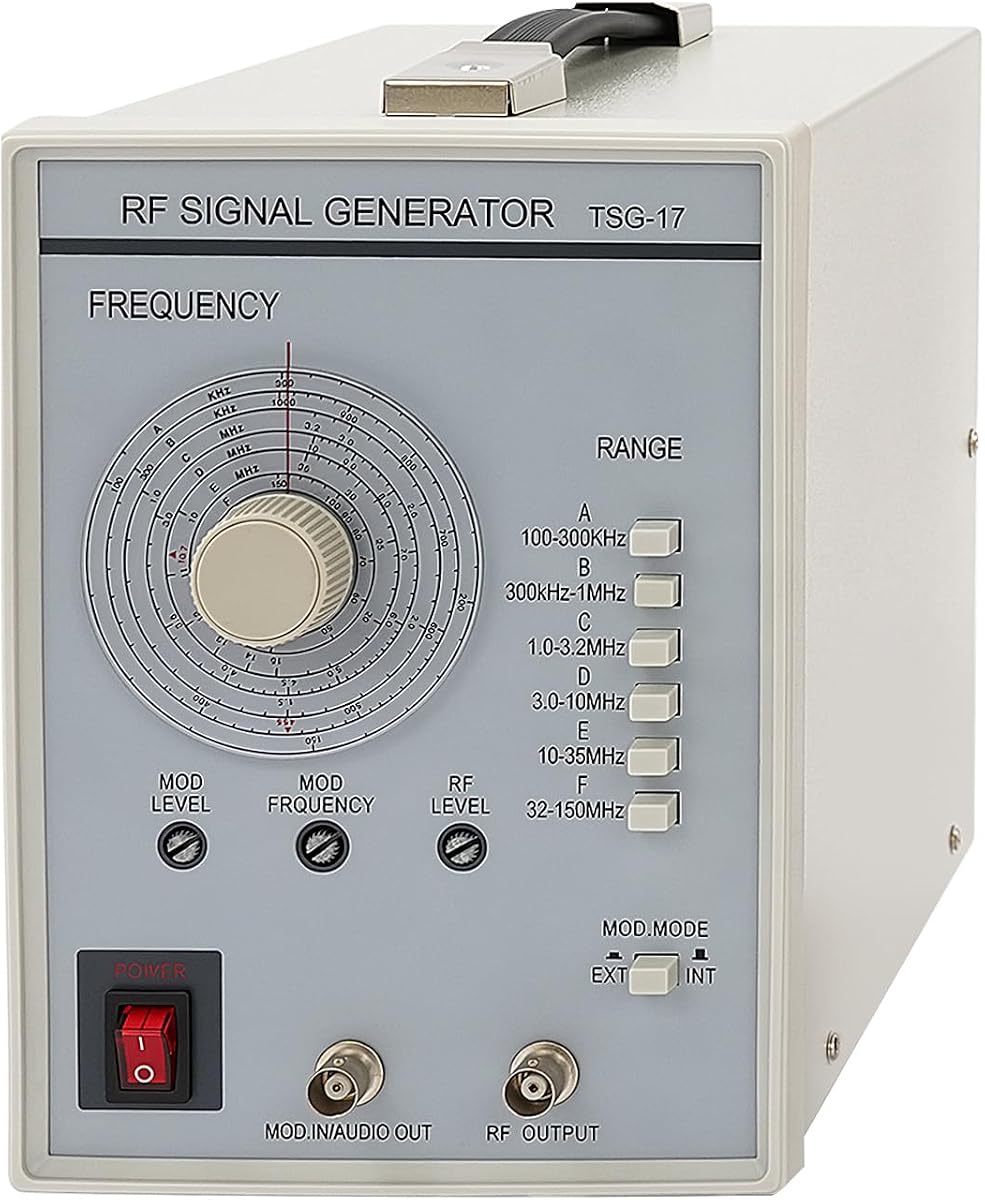
The TSG-17 is built for commercial environments with a 110V power cord for stable operation. It offers high accuracy across a 100kHz to 150MHz range for reliable testing.
We may earn a commission when you buy through this link, at no additional cost to you.
Its ability to output harmonics up to 450MHz extends utility for RF system checks. External modulation allows for flexible signal manipulation during diagnostics.
While lacking a digital display, it is sturdy and reliable for daily use. Technicians in commercial settings find it dependable for standard maintenance tasks.
Ideal for shops and businesses needing a simple, powerful generator. This model works well for consistent commercial applications.
3 harmonic output up to 450MHz supports advanced RF system verification.
Set external modulation signals between 50Hz to 20KHz for varied testing needs.
We may earn a commission when you buy through this link, at no additional cost to you.
This Adjustable Signal Generator is a practical tool for industrial current loop testing. It outputs 4-20mA and 0-12V with built-in protection against shorts.
We may earn a commission when you buy through this link, at no additional cost to you.
The rechargeable battery ensures portability for field technicians who need to test valves or sensors on-site. PWM output allows frequency testing up to 150 kHz.
While battery life depends on load, it offers flexibility without wall power. Users appreciate the safety features that protect both the device and the circuit.
Best for industrial maintenance where portable current signals are needed. This model is a reliable companion for technicians on the go.
Settable voltage and current outputs cover a wide range of industrial simulation needs.
Short circuit and reverse connection protection ensure safe use in testing environments.
We may earn a commission when you buy through this link, at no additional cost to you.
The Riiai 0-10V generator is optimized for PLC and panel debugging. Its encoder knob allows precise adjustments with a 4-digit display for accurate readings.
We may earn a commission when you buy through this link, at no additional cost to you.
You can switch between voltage and current modes easily, and set nine fast output points for quick testing. The rechargeable battery provides enough power for daily tasks.
Though the screen is small, it is clear enough for quick checks. The safe design with short-circuit protection makes it suitable for live systems.
Ideal for technicians needing a portable solution for control panels. This model is a great fit for automated system maintenance.
Rotate the knob to adjust voltage and current with high precision for accurate settings.
Switch between percentage or frequency display modes to match your testing context.
We may earn a commission when you buy through this link, at no additional cost to you.
The Riiai SG003A offers versatile analog simulation for PLC testing with a 2.4-inch TFT screen. It supports current, voltage, and pulse signals in one unit.
We may earn a commission when you buy through this link, at no additional cost to you.
Auto modes allow monotonic rise or fall for testing dynamic responses. The 3000mAh battery lasts up to 26 hours, reducing downtime on the job.
While it may seem complex initially, the presets simplify common tasks. Users value the detailed visual feedback from the real-time curve display.
Best for engineers needing to simulate complex analog signals. This model is ideal for professional PLC and automation testing.
The TFT screen displays input and output curves for better signal monitoring.
Up to 26 hours of working time supports extended field testing sessions.
We may earn a commission when you buy through this link, at no additional cost to you.
The DROK 4-20mA Generator is a simple tool for adjusting PLC values and testing LEDs. It generates both current and voltage signals using a multi-cycle potentiometer.
We may earn a commission when you buy through this link, at no additional cost to you.
This design eliminates the need for complex digital controls, making it easy to use in tight spaces. The compact module fits into many testing scenarios without extra gear.
While it lacks a digital display, the precision potentiometer allows for fine tuning. Users find it handy for quick checks where speed matters more than exact precision.
Ideal for field work requiring basic signal simulation. This model is a great addition to a handy toolkit for general electronics.
A precise potentiometer allows easy rotation to set output values quickly.
Single module generation saves space and reduces equipment complexity for testing.
We may earn a commission when you buy through this link, at no additional cost to you.
Selecting the right Amfm Signal Generator involves considering your specific testing needs, budget, and required features. This guide outlines the key factors to help you make an informed decision.
The frequency range determines which signals the generator can produce. For radio testing, a range up to 150MHz or higher is often necessary.
Ensure the chosen model covers the frequencies needed for your equipment to avoid compatibility issues.
Look for models that support AM and FM modulation, as well as PM or FSK if you need advanced testing.
More modulation options provide flexibility for simulating various communication signals.
Dual-channel generators allow simultaneous output for differential testing. Single-channel models are simpler and often cheaper for basic tasks.
Consider whether your projects require independent signals on two outputs.
Higher resolution like 14-bit ensures precise waveform generation. Accuracy ratings indicate how closely the output matches the desired value.
Choose higher resolution for sensitive applications where minor errors matter.
If you work in the field, a portable unit with a rechargeable battery is essential. Benchtop models may offer more power but less mobility.
Check the power options to ensure they fit your working environment.
Clear displays with intuitive menus help you set up tests quickly. Touchscreens or rotary knobs can improve usability depending on your preference.
A user-friendly interface reduces setup time and potential errors during testing.
USB or PC control allows for automated tests and data logging. Some models offer wireless connectivity for remote operations.
Select connectivity that matches your need for integration with other tools.
Robust materials like metal casings protect the device from drops and impact. Look for units with protective features against shorts or overloads.
A durable build ensures longevity, especially for industrial or frequent use.
Start by connecting the generator to your device using the appropriate cables, such as BNC or alligator clips. Ensure the power supply is stable before turning it on to avoid voltage spikes.
Set the desired frequency and modulation type using the controls or digital menu. Adjust the output amplitude to match the requirements of your test circuit to prevent damage.
After use, disconnect the cables carefully and store the device in a dry place. Clean the screen and knobs with a soft cloth to maintain functionality and extend its lifespan.
An Amfm Signal Generator produces electrical signals to test electronic circuits and radio equipment. It helps verify how devices respond to specific frequencies and modulations in controlled environments.
For most basic tasks, a single channel is sufficient. Dual channels are useful when testing differential circuits or comparing two signals simultaneously in your setup.
Yes, most standalone models operate independently. PC control is an optional feature for automation but is not required for standard signal generation.
Check the operating frequencies of the equipment you are testing. A generator should cover at least the maximum frequency of the device to ensure effective testing.
Yes, when used correctly with appropriate output levels. Always verify the amplitude settings to avoid overloading sensitive components during your tests.
Regular cleaning and proper storage are key. Avoid exposing the unit to extreme temperatures or moisture to maintain performance over time.
We highlighted top models like the UNI-T UTG962E for versatility and the OWON DGE2035 for budget-friendly performance. Each option brings unique strengths depending on your specific application needs.
Consider what matters most to you, such as frequency range, modulation support, or portability. Balancing these factors ensures you select a generator that serves your workflow effectively.
Prices and availability fluctuate, so review current listings before buying. Staying informed helps you secure the best value for your investment in quality test equipment.