
ESP8266 ESP-01S
4.4Editor score
Compact Serial Transceiver
4MB Flash Memory
Low Cost Entry Level
This guide compares the top Arduino WiFi Module options for 2026, evaluating connectivity, performance, and ease of use to help you choose the right device.
Choosing the right Arduino WiFi Module is essential for any modern IoT project. Whether you need simple telemetry or complex edge computing, the wireless layer defines success. Selecting a module that balances power, range, and cost ensures your project scales reliably without hidden hardware limitations.
We evaluated ten leading modules based on wireless standards, processor speed, and ecosystem support. Each product was reviewed for real-world stability, ease of integration with Arduino IDE, and feature richness. Our analysis highlights how each option fits different project needs from beginner prototypes to industrial deployments.
Every pick demonstrates unique strengths in speed, range, or cost efficiency. These summaries help you match hardware capabilities to your specific application requirements quickly. Please note that availability and pricing can fluctuate, so verify current stock before finalizing your purchase decision.
4.4Editor score

4.7Editor score

4.7Editor score
The following table provides a side-by-side comparison of all ten reviewed Arduino WiFi modules. It highlights key specifications such as memory size, wireless protocols, and unique features to help you quickly identify which device best aligns with your project requirements.



The Arduino UNO R4 WiFi stands out as a flagship microcontroller designed for advanced projects. With its dual-core setup combining a Renesas RA4M1 and an ESP32-S3 chip, it delivers significant processing power alongside robust wireless capabilities. This makes it a top choice for users needing reliable connectivity and high-performance computing in a single board.
We may earn a commission when you buy through this link, at no additional cost to you.
Its standout quality lies in the integration of both powerful processing and versatile connectivity features. The 12×8 LED matrix on the board provides immediate visual feedback without needing external displays. Additionally, the inclusion of CAN bus support and Qwiic connectors simplifies industrial and sensor-heavy applications significantly.
While the price is higher than standard boards, the feature set justifies the investment for complex projects. The dual-core design allows tasks to be split efficiently, ensuring smooth operation even under heavy load. The modern USB-C interface further enhances usability by supporting faster programming and stable power delivery.
This board is ideal for developers working on IoT, robotics, or smart home systems. If you need a board that balances performance, connectivity, and ease of use, this is the recommended choice. It ensures your projects have the necessary hardware headroom to grow without needing future upgrades.
The dual-core combination allows for multitasking, where one core handles WiFi while the other runs application logic.
The LED matrix allows for status displays or simple animations without needing additional components or wiring.
We may earn a commission when you buy through this link, at no additional cost to you.
The HiLetgo 3pcs ESP8266 offers a cost-effective way to stock up on reliable WiFi modules. Each unit features the classic ESP8266 chip, known for its balance of performance and affordability. Buying three units at once is practical for projects needing multiple nodes or for prototyping with spares.
We may earn a commission when you buy through this link, at no additional cost to you.
These modules support both Access Point and Station modes, providing flexibility in network setup. The LWIP stack ensures smooth data handling for typical IoT tasks. While basic, they are widely supported in the community, making resources and libraries easy to find for integration.
The compact form factor allows them to fit into tight spaces, but they lack an external antenna which can limit range. Additionally, connecting to a 5V Arduino requires careful voltage management due to the 3.3V logic level. Despite these minor caveats, they remain a solid choice for budget-conscious makers.
This option is perfect for beginners or those building a sensor network with multiple endpoints. The multi-pack ensures you have enough modules for testing and deployment without buying individually. It is a practical solution for scaling up wireless projects economically.
Support for AP and STA modes lets you connect to routers or create standalone hotspots easily.
Buying three units saves money compared to single purchases, ideal for multi-node prototypes.
We may earn a commission when you buy through this link, at no additional cost to you.
The ESP8266 ESP-01S is widely recognized as a standard budget WiFi solution. It improves upon the original 01 model with stronger signal strength and larger 4MB flash memory. This extra space allows for storing more code and features without needing external storage.
We may earn a commission when you buy through this link, at no additional cost to you.
It supports the standard serial AT commands or can be programmed directly via Arduino IDE. The 4MB flash is a significant upgrade over the older 1MB versions, enabling more complex projects. The design is compact, making it suitable for space-constrained applications.
However, the small size means it cannot be plugged directly into a breadboard without a breakout adapter. You must be careful with pin alignment and voltage levels to avoid damage. Despite these handling requirements, the performance per dollar is unmatched in the category.
This module is ideal for low-cost deployments where cost is a primary constraint. Whether you are building a simple sensor or a prototype, this module offers reliable connectivity at a minimal price. It is a staple for developers looking to maximize project scope on a tight budget.
The 4MB flash allows for storing more sketches and local data compared to earlier models.
Upgraded RF design ensures better range and reliability than the original ESP-01.
We may earn a commission when you buy through this link, at no additional cost to you.
The Aitrip 5pcs ESP8266 provides a bulk solution for those needing multiple modules. It uses the standard ESP-01 form factor with 1MB flash, which is sufficient for many basic tasks. The five-pack format is convenient for schools or teams managing several projects simultaneously.
We may earn a commission when you buy through this link, at no additional cost to you.
These modules are designed for smart grids, industrial control, and general IoT applications. They support AP and STA modes, allowing flexible network configurations. The AT command set makes them easy to control via serial terminal or Arduino libraries without deep programming.
Keep in mind that these modules strictly require 3.3V power and I/O levels. Using 5V directly will damage the device, so voltage dividers or logic converters are often needed with standard Arduinos. This adds a slight complexity to setup but ensures stability when connected correctly.
This option is best suited for users planning to deploy many units across different projects. The low cost per unit helps keep overall project expenses down. It is a practical choice for bulk prototyping or educational settings where reliability and cost are key factors.
Five units allow for parallel development across multiple project teams or prototypes.
Designed to handle diverse applications like smart transportation and control systems.
We may earn a commission when you buy through this link, at no additional cost to you.
The ELEGOO 3PCS ESP-32 brings premium performance to a development board bundle. Each board features a dual-core processor capable of reaching 240 MHz, significantly outpacing the ESP8266. This speed allows for more complex logic and simultaneous processing of multiple tasks.
We may earn a commission when you buy through this link, at no additional cost to you.
With integrated Wi-Fi and Bluetooth 4.2, these boards offer extensive connectivity options. The USB-C port simplifies power and programming, while OTA support allows firmware updates over the air. These features make them ideal for connected devices that need to stay current and responsive.
Power-saving modes are included to extend battery life in portable applications. The 32-bit architecture handles heavy lifting better than 8-bit boards. While they cost more, the performance and feature set justify the expense for advanced or commercial-grade prototypes.
This kit is perfect for developers needing high performance and modern connectivity standards. Whether you are building smart home hubs or industrial sensors, these boards provide the necessary power. The three-pack offers value for teams or long-term development projects.
Dual-core 240 MHz allows for running complex algorithms alongside connectivity tasks smoothly.
Combining Wi-Fi and Bluetooth provides flexible options for different device connections.
We may earn a commission when you buy through this link, at no additional cost to you.
The Arduino Nano ESP32 combines a small footprint with high-end ESP32-S3 power. It supports Wi-Fi and Bluetooth 5.0 for robust wireless links. The USB-C interface ensures easy connection, and MicroPython compatibility makes it accessible to Python developers.
We may earn a commission when you buy through this link, at no additional cost to you.
HID support allows this board to act as a custom keyboard or mouse, adding unique input capabilities. The processor speed ensures fast data processing for edge computing tasks. Despite its small size, it packs significant computing power and modern connectivity options.
One consideration is the lack of soldered headers, which requires some assembly effort. This makes it slightly less plug-and-play than standard headers boards. However, for projects where space is limited, this compact design is often a necessary trade-off for the performance gains.
This board is ideal for wearable tech or space-constrained smart devices. If you value Python support and modern USB connections, this is a strong choice. It bridges the gap between traditional Arduino usability and advanced ESP32 features.
Custom input device support enables creating unique interfaces without extra peripherals.
MicroPython compatibility simplifies development for those preferring Python over C++.
We may earn a commission when you buy through this link, at no additional cost to you.
This four-pack of ESP8266 ESP-01S modules offers a balanced quantity for multiple prototypes. The self-calibrated RF ensures optimal performance across units. These modules are designed for reusability, making them practical for iterative development cycles.
We may earn a commission when you buy through this link, at no additional cost to you.
They are well-suited for wearable electronics and sensor networks. The strong signal ensures reliability even in dense environments. Each unit provides solid WiFi connectivity for transmitting sensor data to the cloud or local servers.
While efficient, they require careful handling due to their small size and exposed pins. Soldering is typically needed to connect them to a breadboard safely. This is manageable for experienced hobbyists but might be a hurdle for absolute beginners.
This option is perfect for small production runs or classroom kits needing several units. The four-pack size is flexible for different project scales. It remains a dependable choice for anyone needing consistent performance in a compact package.
Self-calibrated RF tuning ensures consistent signal quality across all units in the pack.
Durable material allows modules to be reused across different projects without performance loss.
We may earn a commission when you buy through this link, at no additional cost to you.
This five-pack provides a solid standard solution for IoT projects. With 4MB flash and a 115200 baud rate, data transfer is efficient. The modules support the DOUT protocol, which is the modern standard for ESP8266 programming.
We may earn a commission when you buy through this link, at no additional cost to you.
They are designed for general Internet of Things applications, offering reliable connectivity. The packaging ensures you have enough spares for testing and deployment. The consistent performance across units makes them a reliable choice for scaling projects.
Programming requires selecting the correct generic board settings in the IDE. Ensuring you use 3.3V power is critical to avoid hardware damage. While these steps add slight complexity, they ensure the module operates at its full potential.
This pack is ideal for developers needing multiple high-performance modules at once. It suits both educational use and prototyping for products. The combination of speed and storage makes these units capable of handling various tasks.
115200 baud rate ensures quick command execution and data transmission for responsive apps.
Support for DOUT protocol aligns with current IDE settings for easier flashing and debugging.
We may earn a commission when you buy through this link, at no additional cost to you.
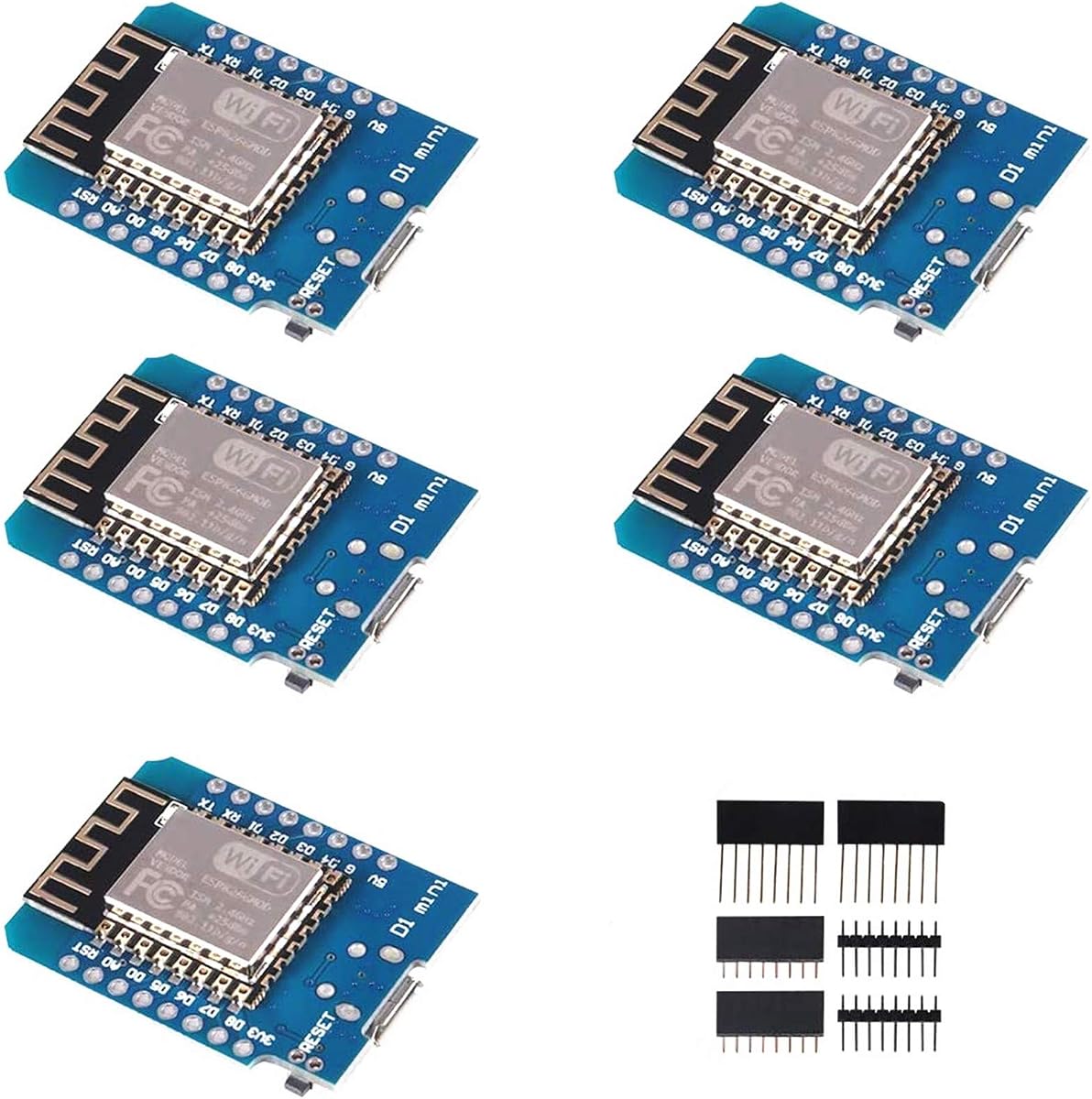
The ESP-12F D1 Mini variant brings more flexibility to the ESP8266 platform. It includes more digital pins than the 01 series, simplifying connections. The built-in USB connector allows easy programming without external adapters.
We may earn a commission when you buy through this link, at no additional cost to you.
It supports Lua and Arduino, making it versatile for different coding styles. The 4MB flash provides ample space for code and local data. This form factor is highly popular for smart plugs and home automation gadgets.
Since it uses 3.3V logic, interfacing with 5V boards requires care. While it fits easily on breadboards, soldering headers might be necessary for robust connections. These requirements are standard for this form factor and manageable with basic tools.
This option is excellent for users wanting a ready-to-use module with extra pins. It suits home automation and sensor projects needing multiple inputs. The balance of connectivity and GPIO availability makes it a versatile choice.
More input/output pins allow connecting more sensors without extra multiplexers.
Integrated USB interface removes the need for separate serial programmers for flashing code.
We may earn a commission when you buy through this link, at no additional cost to you.
The 10-Pack ESP8266 ESP-01 offers the highest quantity option reviewed. It provides robust on-board processing capabilities for complex algorithms. This large pack is perfect for extensive deployments where reliability and scale are paramount.
We may earn a commission when you buy through this link, at no additional cost to you.
It supports standard AP and STA modes for flexible networking. The storage capacity allows for retaining data without external memory. Having ten units ensures you can test, deploy, and have spares without restocking.
These modules are efficient for executing tasks but require breakout boards for use with breadboards. If you are planning a large sensor network or production run, this value is unmatched. The high rating reflects consistent performance across the batch.
This is the best choice for scaling projects significantly. It ensures you have plenty of connectivity units for multiple devices. For teams or schools needing a large stock, this bulk offer provides the best efficiency and convenience.
Ten units ensure enough components for building a large distributed network efficiently.
Strong processing power supports complex logic tasks without needing external processing.
We may earn a commission when you buy through this link, at no additional cost to you.
Selecting the right Arduino WiFi Module depends on your project's specific needs. Understanding key factors like power, memory, and protocol will help you avoid compatibility issues.
Power consumption is a critical factor for battery-powered projects. Look for modules that support sleep modes and have low active current draw. The ESP32 series typically offers better power management than older ESP8266 variants.
Always check the datasheet for active and sleep current ratings before choosing.
Memory capacity determines how much code and data you can store locally. Modules with 4MB flash can handle larger programs than those with 1MB. This is vital for projects with complex logic or local data caching needs.
Choose higher memory options if you plan to store large datasets or complex libraries.
Most WiFi modules operate at 3.3V logic levels, which may differ from 5V Arduino boards. Ensure you use voltage dividers or logic level converters to protect the module from damage.
Always verify the operating voltage requirements before connecting power pins.
Protocol support defines how the module communicates with other devices. Check if the module supports both Access Point and Station modes for flexibility. Some modules also support Bluetooth which adds significant utility for pairing with phones.
Prioritize modules that support the specific network modes required by your application.
Physical size matters for space-constrained projects like wearables. Smaller modules like the ESP-01 are compact but lack breakout headers for easy breadboarding. Larger boards with USB connectors are easier to prototype with but take more space.
Choose the form factor that best fits your final enclosure size and prototyping needs.
Programming interfaces vary from serial-only to USB-C integrated. Modules with built-in USB adapters save space and simplify connections. However, serial-only modules are often cheaper and smaller for final production.
Decide if you need a built-in adapter for convenience or prefer external programmers for cost savings.
Community support affects how easily you can find libraries and troubleshooting help. Modules from major manufacturers usually have more documentation and active forums. This reduces development time when issues arise.
Look for modules that are widely supported by popular Arduino libraries and communities.
When connecting your module, ensure stable power delivery. Many modules require significant current bursts during transmission, so a dedicated capacitor near the VCC pin helps prevent resets.
Avoid exposing the module to extreme temperatures or moisture unless using a rated enclosure. Static electricity can damage sensitive chips, so ground yourself before handling during assembly.
Regularly update your firmware to ensure security and performance. Use tools like the Arduino IDE or Espressif tools to flash new code reliably. Test your code locally before deploying to a remote network.
The Arduino UNO R4 WiFi is ideal for beginners due to its integrated LED matrix and ease of use. It handles both logic and connectivity on one board. The ESP8266 is also popular but requires extra breakout boards.
Yes but you must use a voltage divider for the logic pins. These modules usually operate at 3.3V. Connecting them directly to 5V will damage the module.
ESP32 is faster and supports Bluetooth which 8266 does not. It also has more pins and better power management. Both are compatible with Arduino but ESP32 handles heavier tasks.
ESP32-based modules support Bluetooth Classic and BLE. Older ESP8266 models usually only support Wi-Fi. Always check the chip specs before buying if Bluetooth is required.
Install the ESP Board Manager support in the IDE. Select the correct board like Generic ESP8266. Upload code via USB if supported or a serial programmer.
It is beneficial for complex projects needing more storage. Simple sensors may not need it. But having more space allows for future updates without erasing data.
We reviewed ten top Arduino WiFi Modules covering a range of features and budgets. The UNO R4 WiFi leads for performance while ESP8266 options offer budget flexibility. ESP32 options balance speed and connectivity effectively.
Prioritize memory, voltage compatibility, and power needs based on your project goals. A higher price often justifies reliability and features like Bluetooth or faster processing. Selecting the right module ensures smoother development and stable operation.
Prices and availability change frequently so always verify current stock before ordering. Check the latest specs to ensure compatibility with your chosen platform. With the right module your IoT project will have a solid foundation for success.