
Berkeley Varitronics Octopus 4G LTE
4.6Editor score
True RSRP measurements
No SIM required
US designed
Finding the right cellular signal meter for antenna aiming is essential for optimizing your network setup. Whether you are installing a booster or setting up a remote station, accurate measurement ensures peak performance and reliable connectivity for all your devices.
We evaluated ten leading products based on frequency range, sensitivity, ease of use, and build quality. Our analysis covers devices suitable for homeowners, professionals, and enterprises to help you select the most effective tool for your specific installation needs.
Each pick highlights key features, pros, and cons to simplify your decision process. Please note that product availability and prices may change over time, so verify current details before making your final purchase decision online.
4.6Editor score

4.3Editor score

3.9Editor score
As an Amazon Associate we earn from qualifying purchases.
The following table provides a side-by-side comparison of all ten products to help you quickly identify the specifications that matter most for your antenna aiming tasks.


The SureCall Five-Band RF Signal Meter is a top-rated device designed specifically for cell phone signal booster installation. With a solid rating of 4.3 stars, it offers reliable performance for tuning antennas across multiple cellular frequencies essential for modern connectivity.
We may earn a commission when you buy through this link, at no additional cost to you.
Its standout quality is the five-band support covering PCS, Cellular, AWS, and LTE frequencies. The rechargeable design using four AAA NiMH batteries ensures you can work for hours without interruption. High receiving sensitivity of -110dBm allows for accurate detection even in weak signal areas.
One trade-off is the variable battery life between 2.5 to 3.5 hours which may require recharging during long sessions. However, the controllable backlight is a practical feature for dark environments like attics or crawl spaces where you often install antennas.
This meter is best for homeowners and technicians installing signal boosters who need precise tuning capabilities. The detailed band support ensures you optimize your antenna for the right frequencies. We recommend this device for anyone prioritizing reliability and coverage in their antenna aiming setup.
The five-band support ensures you can tune antennas for all major carriers without switching devices.
Rechargeable NiMH batteries provide sustainable power for extended installation jobs without frequent swaps.
We may earn a commission when you buy through this link, at no additional cost to you.
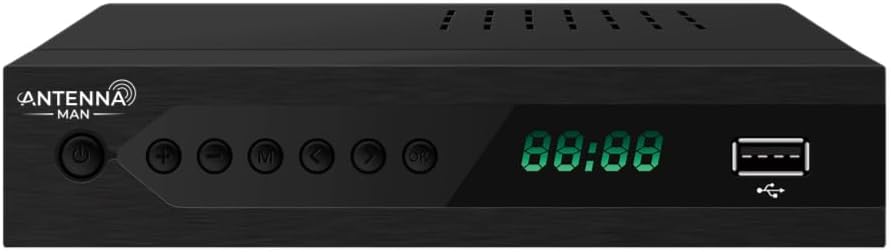
The Antenna Man Signal Meter serves as an ATSC Digital Converter Box with TV Tuner and Recording features. It holds a rating of 3.8 stars and is suitable for users needing digital over-the-air signal measurements rather than cellular boosting.
We may earn a commission when you buy through this link, at no additional cost to you.
Its key strength is the real-time signal strength display which allows you to see adjustments instantly. The plug-and-play setup means you can start using it immediately without complex calibration. It supports getting more channels by helping you find the strongest broadcast source.
The main trade-off is that it is designed primarily for ATSC signals and may not cover cellular frequencies needed for boosters. Users looking specifically for 4G LTE measurement might find this limited. However for its recording capability adds value for analyzing signal stability over time.
This device is ideal for OTA antenna installers who need a reliable tuner and meter combo. If you are setting up a TV antenna or need basic signal monitoring, it offers a straightforward solution. We suggest it for those who prioritize ease of use over cellular band diversity.
Real-time signal strength display helps you adjust antenna direction instantly for optimal reception.
Combines signal meter and digital converter box to simplify your OTA antenna setup process.
We may earn a commission when you buy through this link, at no additional cost to you.
The Berkeley Varitronics Octopus 4G LTE is a high-end device rated 4.6 stars designed for EV charging stations, cell boosters, and IoT devices. It offers true RSRP RSRQ and RSSI measurements which are critical for professional network analysis.
We may earn a commission when you buy through this link, at no additional cost to you.
Its standout quality is the true network support for AT&T Verizon T-Mobile and all U.S. regional carriers without requiring SIM cards or phones. The True RSRP measurements provide precise data for optimizing antenna aim. Being designed and manufactured in the U.S.A adds to its reliability.
One trade-off is the high price point which may not suit casual users. It is an advanced tool meant for professionals rather than home users. However, the accuracy and lack of subscription requirements justify the investment for those who need exact data for commercial or complex setups.
We recommend this for engineers and installers working on IoT devices or EV charging sites. The precision ensures your antenna is aiming at the strongest tower with the correct metrics. If you need the best accuracy for cellular signal meter for antenna aiming this is the top choice.
True RSRP RSRQ and RSSI measurements ensure you optimize your antenna based on real network data.
Supports all major US carriers without needing SIM cards or phone connections for testing.
We may earn a commission when you buy through this link, at no additional cost to you.
The RF Explorer Pro Spectrum Analyzer is a comprehensive RF measurement platform covering 15MHz to 6.1GHz. It does not have a rating yet but offers a powerful suite of tools for engineers and RF professionals needing detailed spectrum analysis.
We may earn a commission when you buy through this link, at no additional cost to you.
Its standout quality is the 8-inch high-definition touchscreen which provides clear visualization of RF signals in real time. It includes advanced features like GPS Heatmap and Frequency Coordination modes for thorough testing. The portable design and rechargeable battery allow up to 5 hours of operation.
One trade-off is that the complexity might be overwhelming for simple antenna aiming tasks. It is designed for more than just basic signal strength checks. However, for users needing interference analysis or cable diagnostics, this device provides unmatched depth and visualization capabilities.
We suggest this for advanced users or professionals needing more than a simple meter. The broad frequency coverage ensures you can analyze any signal in your environment. If you need a versatile tool that includes spectrum and power meter functions this is an excellent choice.
Advanced RF analysis tools and GPS heatmap help identify sources of interference in your area.
Compact design with 5-hour battery life makes it suitable for on-site testing anywhere.
We may earn a commission when you buy through this link, at no additional cost to you.
The NetAlly AirCheck G3 Pro Kit is a complete professional kit with a perfect 5-star rating. It includes an external directional antenna and NXT-2000 Tri-Band Spectrum Analyzer, specifically designed for Wi-Fi 6/6E and Bluetooth testing.
We may earn a commission when you buy through this link, at no additional cost to you.
Its standout quality is the advanced testing apps and purpose-built hardware that validate network performance for critical services. Tri-band physical location detection helps find access points and clients quickly. The centralized data management platform allows seamless integration with network management systems.
One trade-off is the very high price and focus on Wi-Fi rather than cellular frequencies. It is not the typical cellular signal meter for antenna aiming but for hybrid environments it is unmatched. If your primary need is Wi-Fi troubleshooting this kit offers professional grade support.
We recommend this for network engineers managing enterprise wireless infrastructure. The inclusion of remote collaboration and topology mapping makes complex site surveys much easier. For those prioritizing Wi-Fi and Bluetooth testing accuracy this kit is the absolute best choice.
Test and verify Wi-Fi 6/6E and Bluetooth/BLE networks with advanced purpose-built hardware tools.
Remote collaboration and centralized data management make site surveys easier across locations.
We may earn a commission when you buy through this link, at no additional cost to you.
The Extech 480836 RF EMF Strength Meter is rated 4.3 stars and covers high frequency measurements from 50MHz to 3.5GHz. It is ideal for EMF measurements of mobile phones base stations and microwave leakage rather than just cellular aiming.
We may earn a commission when you buy through this link, at no additional cost to you.
Its standout quality is the non-directional isotropic measurement with three-channel triaxial probe which ensures accurate readings from all directions. Manual store recall up to 99 sets allows you to save data for later analysis. The build quality is robust for field use.
One trade-off is that it is designed for EMF safety and broad RF rather than detailed cellular signal aiming. While it covers relevant frequencies it may not offer the specific band detail needed for boosters. However for for safety checks it is excellent.
We recommend this for safety professionals or users concerned with EMF exposure. The isotropic measurement ensures you capture the true field strength accurately. If you need to verify signal strength for safety rather than tuning antenna aim this device meets your needs.
Non-directional isotropic measurement captures field strength from all angles for safety assessments.
Manual store recall allows you to save up to 99 sets of measurements for later review.
We may earn a commission when you buy through this link, at no additional cost to you.
The MINI1300 Antenna Analyzer is rated 4.4 stars and features a 4.3 inch large-screen LCD touching screen display. It covers frequency range 0.1 to 1300MHz supporting HF VHF and UHF bands for radio enthusiasts and antenna tuners.
We may earn a commission when you buy through this link, at no additional cost to you.
Its standout quality is the measurement modes including single point measurement scanning frequency sweep and TDR Mode. Portable and compact design makes it easy to operate and carry to field sites. The SWR measurement range supports up to 1.0 to 1999 in single point mode.
One trade-off is the note that firmware cannot be updated without damaging original function. It is also more focused on RF amateur bands than cellular 4G LTE aiming. However for SWR checks it provides a solid touch-based interface and reliable frequency sweep.
We recommend this for amateur radio operators and antenna builders who need precise SWR tuning. The touchscreen interface simplifies the process of finding resonant points. If you need a portable analyzer for HF VHF and UHF this unit is well suited.
4.3 inch touchscreen simplifies operation for single point and scan modes in the field.
Wide SWR measurement range allows precise tuning for HF VHF and UHF antenna setups.
We may earn a commission when you buy through this link, at no additional cost to you.
The SA6 6GHz Portable Spectrum Analyzer integrates a spectrum analyzer and signal generator. It covers 35-6200MHz and supports WiFi LTE 2G 3G 4G GSM CDMA and GLONASS. It is rated N/A but offers a wide frequency range for wireless signal troubleshooting.
We may earn a commission when you buy through this link, at no additional cost to you.
Its standout quality is the 2-in-1 design which allows instant mode switching for RF testing. The 3.2-inch color touchscreen provides real-time spectrum viewing. Built-in rechargeable battery provides approximately 3-4 hours of continuous use and USB Type-C port supports connectivity.
One trade-off is the complexity which might be steep for simple antenna aiming. However the wide frequency range ensures you can test most common wireless signals. The lightweight portable design at 380g makes it easy for technicians to carry on site.
We recommend this for technicians needing a versatile RF tester. The tracking generator supports frequency response measurements for filters and amplifiers. If you need a compact tool that handles WiFi cellular and RF testing this SA6 is a strong choice.
Switch instantly between spectrum analyzer and signal generator modes for efficient testing.
Supports WiFi LTE GSM CDMA and GLONASS for comprehensive signal analysis.
We may earn a commission when you buy through this link, at no additional cost to you.
The For Sa6 6GHz Handheld is a compact spectrum analyzer and signal generator combo. It covers 35-6200MHz supporting WiFi 4G LTE GSM and more. Rated N/A it includes a rugged design and everything needed to start analyzing immediately.
We may earn a commission when you buy through this link, at no additional cost to you.
Its standout quality is the integrated tracking generator which delivers stable output to characterize filters and amplifiers. Real-Time spectral measurement with fixed 200 kHz resolution allows rapid assessment. The compact 5.9 inch housing is energy efficient and built for tight spaces.
One trade-off is the lack of specific rating for this generic model which means reliability may vary. The battery is 2500 mAh providing up to 3 hours runtime which is decent for field tasks. For value conscious users it offers robust features.
We recommend this for hobbyists needing affordable RF tools. The included extension cables and data cable help you get started without extra costs. If you want a rugged portable device for onsite maintenance this unit delivers practical performance.
Includes charging data cable extension cables and KK connector to start analyzing immediately.
Real-time spectral measurement allows quick RF environment assessment in minutes.
We may earn a commission when you buy through this link, at no additional cost to you.
The Channel Master TV Antenna Signal Strength Meter is a digital handheld signal finder with a 3.9 rating. It supports all over-the-air ATSC TV frequencies within the USA and displays signal level and SNR. It includes a stylus and protective carrying case for precise antenna alignment.
We may earn a commission when you buy through this link, at no additional cost to you.
Its standout quality is the color touch-screen display which is intuitive for most users. The built-in rechargeable battery ensures you can work without carrying extra power packs. It is designed specifically for OTA antenna alignment and installation with accurate SNR reading.
One trade-off is that it is limited to ATSC frequencies and not cellular boosting. If you need a cellular signal meter for antenna aiming for mobile boosters this will not work. However for TV antenna setup it is a reliable and affordable tool.
We recommend this for homeowners installing TV antennas who want to optimize reception. The stylus and case add value for protection and ease of use. If you are focused on over-the-air TV signals this budget option provides accurate signal strength reading.
Designed for precise OTA antenna alignment with detailed signal level and SNR display.
Color touchscreen simplifies navigation for quick antenna setup in any environment.
We may earn a commission when you buy through this link, at no additional cost to you.
Selecting the right tool depends on your specific frequency needs and technical requirements.
Ensure the device covers the bands you need such as 700/800/1700/2100MHz LTE. Devices like the Berkeley Varitronics Octopus cover all major carriers without SIM cards.
Check that the meter supports PCS Cellular AWS and LTE bands for comprehensive booster tuning.
Look for True RSRP RSRQ and RSSI measurements for professional accuracy. These metrics provide deeper insight than simple signal bars.
High sensitivity like -110dBm ensures you can detect weak signals during aiming.
Touchscreen interfaces like on the RF Explorer Pro or MINI1300 simplify operation in the field. A larger screen helps visualize real-time changes.
Backlights or color displays are essential for working in dark spaces like attics.
Rechargeable batteries or NiMH options reduce downtime during installation. Look for devices offering 3+ hours of runtime.
Check if USB connectivity allows for external power in long sessions.
Lightweight portable designs are easier to carry on rooftops or remote sites. Devices like the Extech 480836 offer robust field use.
Carrying bags or cases protect the meter from damage during transport.
Tools with GPS heatmap or tracking generators help analyze complex environments. These add value for engineers and professionals.
Check if the device supports SWR or cable diagnostics for broader testing needs.
Professional tools like the NetAlly AirCheck G3 Pro Kit offer advanced features but at a high cost. Determine if you need enterprise grade capabilities.
Budget options like the Channel Master provide specific functionality for OTA at a lower price.
Start by connecting the meter to the antenna cable securely. Turn on the device and wait for the signal to stabilize before adjusting the antenna direction.
Observe the signal strength changes on the display as you rotate or tilt the antenna. Find the position where the reading is highest for optimal performance.
Store the meter in a protective case when not in use to prevent screen damage. Keep the battery charged and check calibration periodically for accuracy.
A reliable meter should cover the major bands used by your carrier such as 700/850/1900MHz for Verizon AT&T and 1700/2100MHz for T-Mobile. Ensure the device includes PCS Cellular AWS and LTE bands for comprehensive compatibility.
Not all meters require a SIM card. Devices like the Berkeley Varitronics Octopus offer true RSRP measurements without needing SIM cards or phones. Always check the specific product requirements before purchasing.
Higher dBm values indicate stronger signals. Aim for values closer to 0 dBm (e.g. -60dBm) for optimal antenna alignment. Always compare real-time readings to find the peak during adjustment.
No. TV meters cover ATSC frequencies while cellular boosters need specific LTE bands. Ensure the device supports cellular frequencies to avoid incorrect measurements for mobile signal enhancement.
RSRP stands for Reference Signal Received Power which is a precise measure of signal strength. It helps you target the strongest tower accurately for professional antenna tuning and network optimization.
Battery life varies but many meters offer 3 to 5 hours of operation. Models with rechargeable designs like the SureCall or RF Explorer provide extended use without frequent battery changes.
Yes advanced devices benefit from periodic calibration to maintain accuracy. Always follow the manufacturer guidelines for calibration to ensure reliable measurements during installation.
Yes many devices like the Berkeley Varitronics Octopus support both residential and commercial needs. However ensure you have the necessary features like True RSRP for professional commercial requirements.
The top picks cover a range of needs from budget-friendly to professional grade. The SureCall Five-Band is excellent for boosters while the Berkeley Varitronics Octopus provides advanced accuracy.
Prioritize frequency coverage and measurement accuracy when selecting your tool. Ensure the device matches the specific bands and metrics required for your antenna setup.
Always check current prices and availability as product details may change. Verify that the tool supports your specific network needs before finalizing your purchase online.