
Donner Amp Attenuator Pedal
4.3Editor score
True bypass design
Mute footswitch included
Compact pedal format
Discover the top attenuator for tube amp options for 2026. This guide compares power attenuation, reactive loads, and tone preservation features.
Finding the right attenuator for tube amp systems is crucial for musicians who want to push their gear without drowning out the room. These devices allow you to achieve natural tube saturation at lower volumes, preserving the dynamic feel and tone that define great guitar sounds.
We evaluated ten leading models based on power handling, impedance matching, and signal integrity. Our analysis focuses on how each unit interacts with tube amplifiers to maintain the sweet spot while reducing output volume for practice or recording scenarios.
Each pick highlights specific strengths like reactive loading or built-in DI options. Keep in mind that product availability and pricing can shift over time, so verifying current specs before purchase ensures you get the right match for your rig.
4.3Editor score

4.3Editor score

4.4Editor score
This side-by-side comparison outlines the key specifications and capabilities of each model to help you decide which unit fits your specific amplifier and usage needs.



The Bugera POWER SOAK PS1 stands out as a highly rated solution for players needing volume control without sacrificing tone. With a 4.3 rating from users, it delivers reliable passive attenuation for amplifiers up to 100 watts. Its standout quality lies in the built-in emulated mic output, which simplifies direct recording setups.
We may earn a commission when you buy through this link, at no additional cost to you.
This unit supports 4, 8, and 16 ohm inputs, making it versatile for nearly any tube amp configuration. The line output with dedicated level control gives you flexibility to send signals to interfaces or mixers directly. Musicians appreciate that it retains the amp's feel while reducing stage volume significantly.
While it is passive and can get warm during extended use, this is standard for resistor-based attenuators. The metal enclosure is sturdy but adds weight to your gig bag. These trade-offs are acceptable given the price point and functionality offered for home and studio use.
Buy this if you need an affordable way to record tube tones quietly or play at lower volumes live. It is an excellent choice for intermediate players looking for a solid entry into power attenuation without spending on advanced modeling features.
The multi-impedance inputs ensure you can connect various amp heads safely without mismatching impedance risks.
The emulated mic output lets you bypass a physical microphone and send a speaker-like signal straight to your interface.
We may earn a commission when you buy through this link, at no additional cost to you.
The JHS Little Black Amp Box is a favorite for guitarists who want simplicity and portability. Rated 4.6 by users, it tames loud tube amps by sitting in the effects loop to control signal sent to the power section. Its compact design allows it to live seamlessly under any pedalboard.
We may earn a commission when you buy through this link, at no additional cost to you.
High grade components ensure your tone remains clear and pure while you push the front end of your amp. You retain the sweet spot response at lower levels, which is crucial for dynamic playing. Since it is passive, there are no power cables or active electronics to fail.
The lack of a direct output means you still need a speaker cabinet to function as a load. It is also not adjustable beyond its fixed attenuation, so you cannot dial in exact decibel cuts. This limits flexibility but adds to the plug-and-play reliability.
This unit is best for players who already have a speaker setup and just need volume reduction. If you want a straightforward tool to keep your amp happy at low volumes without complex features, this box is a proven solution.
Its small footprint allows easy mounting under most standard pedalboards without taking up valuable control space.
The passive circuit ensures no coloration is added to your signal, keeping the natural character of your amp intact.
We may earn a commission when you buy through this link, at no additional cost to you.
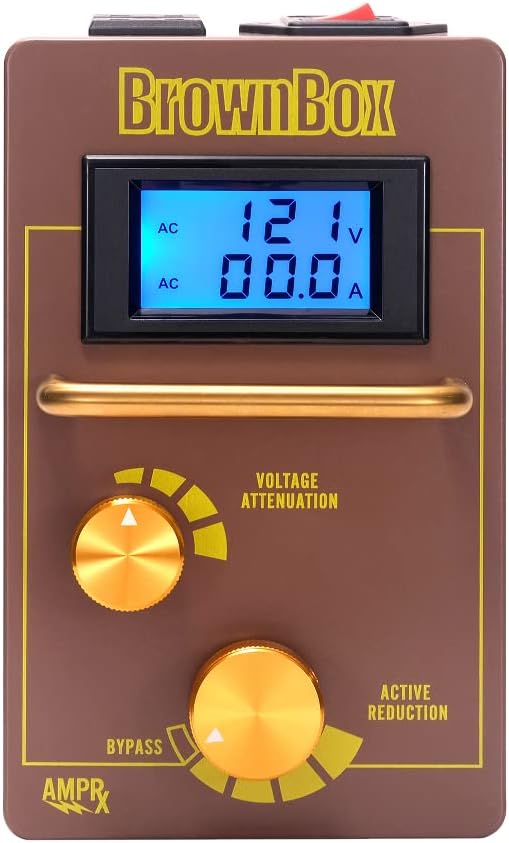
The BrownBox is designed for those who want to adjust the voltage supplied to their tube amplifier directly. With a perfect 5.0 rating, it offers a unique approach to tone shaping by controlling input voltage to manage output power. The built-in LCD voltmeter provides visual feedback for precise adjustments.
We may earn a commission when you buy through this link, at no additional cost to you.
It supports full-sized tube amplifiers and offers four selectable input and output voltages. This flexibility allows you to dial in the exact power level you need without changing speakers or using traditional load attenuation. It is an excellent choice for vintage amp restorations or specific tone quests.
Setup requires care to ensure the correct voltage settings are applied to avoid damaging sensitive components. The price is higher than basic attenuators, but the functionality is distinct for controlling plate voltage. This makes it a niche tool for advanced users rather than general volume reduction.
Choose this if you are technically inclined and want to control amp power via voltage reduction. It is ideal for studios or labs where precise power management is needed to replicate specific vintage characteristics or protect older gear.
The LCD voltmeter ensures you always know the exact voltage level entering the amp, reducing risk of overload.
Four selectable output voltages give you granular control over how hard the amp tubes are driven.
We may earn a commission when you buy through this link, at no additional cost to you.
The Tone King Ironman II Mini delivers reactive attenuation for smaller tube amps up to 30 watts. Users rate it highly at 4.6 due to its ability to maintain the natural feel of a speaker cabinet. It is compact yet packed with features like a footswitchable boost for solos.
We may earn a commission when you buy through this link, at no additional cost to you.
This model operates at 8 ohms and includes a line output for direct recording. Reactive loads are preferred by many because they mimic speaker impedance changes, ensuring the amp responds as expected. It is well-suited for bedroom players or recording environments where space is limited.
The 30-watt limit means it cannot handle high-powered amp heads. You also cannot switch impedance on the fly, which might limit compatibility with some gear. However, for standard 8 ohm setups, it provides a premium listening experience without the bulk of larger units.
Buy this if you need a high-quality reactive load for low to mid wattage amps. It is a great option for players who want tone accuracy and recording flexibility in a small, portable package.
Reactive technology ensures the amp interacts with the load just like a real speaker, preserving dynamics.
The footswitchable boost provides a volume lift for solos without needing to change pedal settings.
We may earn a commission when you buy through this link, at no additional cost to you.
The Donner Amp Attenuator Pedal is an entry-level choice for players seeking volume control on a budget. With a 4.3 rating, it uses high-quality electronic components to keep tone clear. It runs through the effects loop and lets you push the front end of the amp safely.
We may earn a commission when you buy through this link, at no additional cost to you.
You can set the output level to minimum with the onboard knobs for silent practice. The mute footswitch is a handy tool for stopping sound quickly without touching the amp. It retains dynamics and tone at lower levels, making it effective for home recording.
It requires a separate DC 9V adapter which is not included in the package. The circuit is basic compared to reactive units, so there may be some tone loss at high attenuation. This is a trade-off for its affordable price point and compact pedal form factor.
This pedal is best for beginners or those on a tight budget who want simple attenuation. If you need an affordable way to tame volume without complex features, this pedal delivers solid value for the cost.
The dedicated mute footswitch allows you to silence the signal instantly for silent changes or pauses.
High-quality components help maintain the purity of your signal as it passes through the attenuation circuit.
We may earn a commission when you buy through this link, at no additional cost to you.
The Two Notes Torpedo Captor combines a reactive load, DI, and attenuator in one compact unit. It scores 4.5 from users who need direct recording solutions. Its speaker simulation capability allows you to plug directly into an interface without miking a cabinet.
We may earn a commission when you buy through this link, at no additional cost to you.
The 8 Ohm load is ideal for most modern tube amps. It handles attenuation well while preserving tone quality. The direct box output makes it easy to route signals to mixers or recording gear. This is perfect for studio environments where space is at a premium.
It lacks the advanced digital features of the full Captor X, which means you cannot edit cabinet responses without software. The fixed 8 Ohm load requires you to ensure your amp matches. Despite this, it remains a reliable workhorse for direct audio capture.
Choose this if you want a simple box to record guitar amps directly without microphones. It is a great choice for home studios that need to capture tone quickly without setting up complex mic setups.
The DI output lets you send a line-level signal straight to your audio interface for clean recording.
This acts as a dummy load allowing you to run the amp without a real speaker cabinet.
We may earn a commission when you buy through this link, at no additional cost to you.
The Universal Audio Ox Amp Top Box is the pinnacle of tube amp attenuation for recording. With a 4.4 rating, it offers a no-compromise analog reactive load system. It delivers instant album-quality mic and cabinet tones via the front panel RIG control.
We may earn a commission when you buy through this link, at no additional cost to you.
You get five attenuation levels ranging from silent to full band volume, giving total control over loudness. UA Dynamic Speaker Modeling emulates speaker drive and breakup, capturing the nuances of real cabinets. This allows you to achieve record-ready sounds without miking.
The cost is significant compared to other options, making it an investment for serious producers. Setup may require desktop software for full customization which adds complexity. However, for those demanding the highest fidelity and flexibility, the performance justifies the expense.
Buy this if you are a professional looking to eliminate mic setups and get perfect sounds fast. It is the top choice for studios that want to combine tube amp power with modern recording convenience.
Virtual mics and cabs let you experiment with sounds physically without moving hardware.
Modeling captures speaker breakup and cry for a more realistic response than standard loads.
We may earn a commission when you buy through this link, at no additional cost to you.
The Warm Audio Reamper Routing Hub is designed for advanced studio routing and attenuation. It acts as a central hub with independent preamp re-amp signal paths to manage signal flow. The silent 50W power soak allows you to run amps without speaker volume.
We may earn a commission when you buy through this link, at no additional cost to you.
Variable impedance control gives you the ability to tweak the load to match your amp perfectly. This ensures the natural tone and feel are retained. It is ideal for engineers who need to split signals or route multiple paths simultaneously.
It is less about simple volume reduction and more about complex signal management. There is no direct DI output which means you must plan your chain carefully. This makes it a specialized tool rather than a general attenuator for casual players.
Choose this if you run a studio setup needing flexible signal routing and power soaking. It is a great tool for engineers who want to reamp or manage multiple guitar chains with precision.
Variable impedance lets you fine-tune the load to match the amp's natural output characteristics.
Independent paths allow complex setups where signals need to be split or reprocessed easily.
We may earn a commission when you buy through this link, at no additional cost to you.
The Tone King Ironman II 100-Watt handles high-powered tube amps with precision compensation. It receives a 4.2 rating for its ability to deliver reactive attenuation up to 100 watts. The analog cabinet simulation ensures your direct signal sounds authentic without mic coloration.
We may earn a commission when you buy through this link, at no additional cost to you.
It includes dual impedance controls and a presence switch for tone shaping. This unit is robust enough for gigging musicians who need reliable performance under demanding conditions. The bypass mode lets you run full volume when needed without disconnecting the unit.
The size and weight are substantial due to the power handling components. The cost is also higher than lower wattage options which may not fit all budgets. For players who need to tame big amps, these trade-offs are often worth it for reliability.
Buy this if you need a durable attenuator for 100-watt tube heads. It is a solid choice for pros who need to reduce stage volume while maintaining tone quality and recording flexibility.
Supporting 100 watts ensures you can handle large amp heads without risk of overheating.
Analog cabinet simulation provides a natural sound for direct recording without digital modeling.
We may earn a commission when you buy through this link, at no additional cost to you.
The Boss WAZA Tube Amp Expander is a command center combining an attenuator with a built-in power amp. It supports tube amps up to 150 watts and allows user-adjustable impedance tuning. This keeps the natural tone and dynamics intact by matching the load exactly.
We may earn a commission when you buy through this link, at no additional cost to you.
You get ten recallable rig settings to store favorite setups for quick changes. The built-in 100-watt Class AB amplifier provides seamless volume control directly. It offers a complete solution for tone management without needing external cabs.
The cost is high, positioning it as a luxury item for enthusiasts. The size is large, so it needs significant space in a studio. Despite this, the level of control and integration is unmatched for those seeking a standalone system.
Choose this if you want a comprehensive system to expand and control your amp setup. It is best for serious players who value detailed control and built-in amplification for a seamless workflow.
Adjustable impedance tuning ensures the load matches your amp perfectly to retain its natural feel.
Ten rig settings let you save and recall configurations easily for different songs or bands.
We may earn a commission when you buy through this link, at no additional cost to you.
Selecting the right attenuator requires considering wattage, impedance, and desired output features.
Ensure the attenuator can handle your amp's output wattage. Exceeding limits can cause overheating or damage to the unit or amplifier.
Always choose a unit rated equal to or higher than your amp's max wattage.
Mismatched impedance can lead to poor tone or equipment failure. Check if the unit supports your amp's specific ohm output.
Multi-impedance options offer more flexibility for different gear.
Reactive loads mimic speaker impedance for better tone retention. Passive units are simpler but may change tone at high attenuation.
Reactive is preferred for recording accuracy; passive suits general volume reduction.
Look for line or DI outputs if you plan to record directly. Emulated speaker outputs save the need for microphones.
Built-in speaker simulation streamlines your studio workflow.
Pedalboard units are compact for gigs but limited in power handling. Rack or box units handle higher wattage but take more space.
Choose based on whether you prioritize stage size or studio power.
Features like footswitchable boost, presence controls, or adjustable impedance add versatility. These can replace other pedals in your chain.
Evaluate if these features save cost or complexity in your setup.
Prices vary widely based on technology. Passive units are affordable while reactive and modeling units cost more.
Set a budget that balances necessary features with financial constraints.
Solid metal construction ensures durability during travel. Warranty terms indicate manufacturer confidence in product longevity.
Prioritize units with proven durability and support.
Connect the output of your amp to the attenuator input, then connect the speaker output to your cabinet or load. Ensure all connections match the impedance ratings.
Power on the amp at full volume for the first few minutes to warm up tubes. Then adjust the attenuator knob to your desired volume level gradually.
Allow the unit to cool down after long sessions to prevent overheating. Store it in a dry place and keep metal contacts clean to maintain signal quality.
Yes, a speaker cabinet is typically required as the load. Some units have built-in speaker sims for direct output, but you must ensure there is a proper load attached to prevent amp damage.
Passive units may slightly affect tone at high attenuation, but reactive models generally preserve tone well. The best units are designed to maintain the amp's dynamic feel even at lower volumes.
Most tube amps are compatible if the impedance matches. You should check the specific wattage and ohm requirements of both your amp and the attenuator to ensure safe operation.
Resistive attenuators convert excess power into heat, which is normal. Ensure you have adequate ventilation and do not exceed the unit's wattage rating during use.
A DI output is useful for direct recording into interfaces without microphones. It adds convenience but may not be essential if you prefer miking cabinets for tone.
Attenuators typically offer reductions from 6dB to 30dB depending on the model. This allows you to go from stage volume to whisper quiet while keeping the amp at full gain.
Attenuators are designed for tube amps which require a reactive load. Solid state amps have different power supplies, so always check the manufacturer's compatibility before connecting.
Many attenuators have speaker simulation outputs allowing direct recording without microphones. This simplifies your setup and lets you capture tone instantly in a studio.
We have reviewed ten top options including the Bugera POWER SOAK PS1 and Universal Audio Ox Amp Top Box for their respective strengths.
Prioritize reactive load technology and impedance matching to ensure your tone remains dynamic and natural at lower volumes.
Always verify current pricing and availability before purchasing to ensure you select the right model for your amplifier setup.